
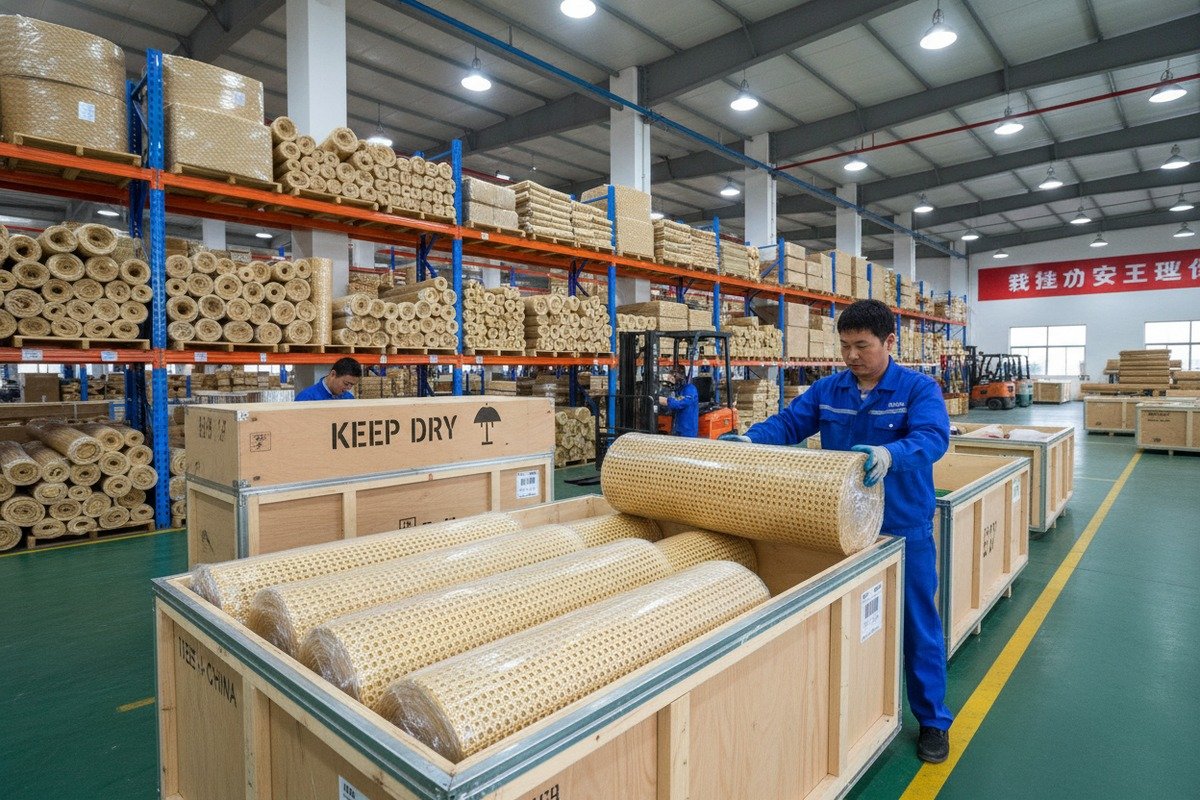
Every year, our warehouse team sees the same heartbreaking photos from buyers — beautiful rattan cane webbing 1 that arrived moldy, crushed, or cracked beyond use. After shipping thousands of rolls from our factories in Foshan and Indonesia to over 30 countries, we know exactly what goes wrong and how to stop it moisture-barrier packaging 2. The damage is preventable, but only if you take the right steps before the container door closes.
To prevent rattan cane webbing damage during shipping, you must combine tight professional rolling, moisture-barrier packaging, breathable protective coverings, proper drying before dispatch, desiccant placement, sturdy outer boxes or crates, and clear fragile labeling to guard against mold, crushing, fraying, and cracking throughout transit.
This guide breaks down every method we use and recommend. Whether you buy full rolls or custom-cut pieces, these steps will save you money, time, and frustration. Let’s walk through each critical area one by one.
How can I ensure my rattan cane webbing is packed securely to avoid fraying during transit?
Fraying is one of the most common complaints we hear from first-time buyers. When rolls arrive with loose, unraveled edges, the material becomes unusable for furniture restoration or decor projects. In our experience exporting to the US, Europe, and the Middle East, fraying almost always traces back to how the webbing was rolled and wrapped before it left the factory floor.
To avoid fraying during transit, ensure your rattan cane webbing is tightly rolled onto sturdy cores, edges are taped or heat-sealed, and each roll is individually wrapped in protective film followed by kraft paper before being placed in reinforced outer packaging.
Why Does Rattan Fray in the First Place?
Rattan is an organic, fibrous material 3. The strands in a woven sheet are interlocked, not glued. When a roll shifts inside its box, the edges rub against cardboard or other surfaces. Over 8 to 20 days of sea freight vibration 4, this rubbing loosens the outer strands. The result is fraying that can extend several centimeters into the usable area.
Cut pieces face even higher risk. When a supplier cuts webbing to your requested size, the freshly cut edge has no natural termination point. Without reinforcement, those cut strands will unravel fast.
Key Steps to Prevent Fraying
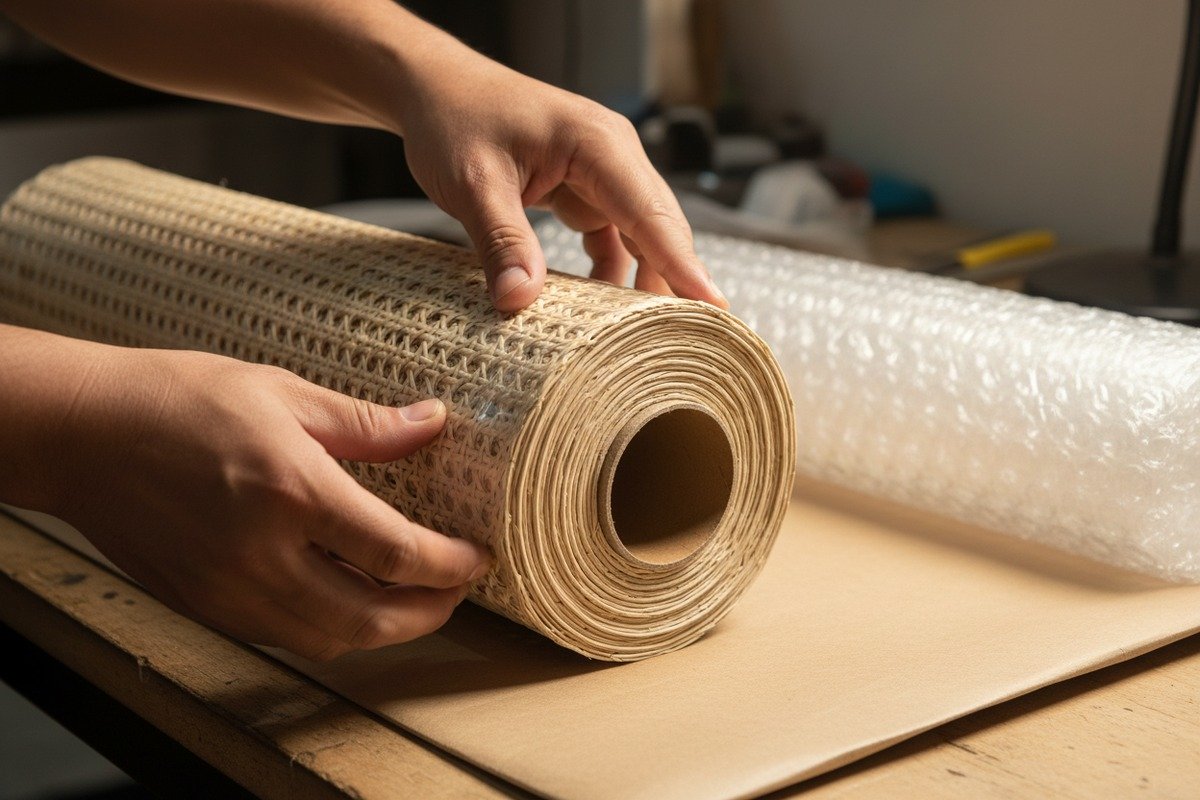
First, ask your supplier to roll webbing onto a rigid cardboard or PVC core 5. A loose roll without a core will collapse and crease, creating stress points where fraying starts.
Second, request edge taping. A strip of clear packing tape along both edges of the roll holds the outermost strands in place. Some suppliers use heat-sealing for synthetic rattan, which is even more durable.
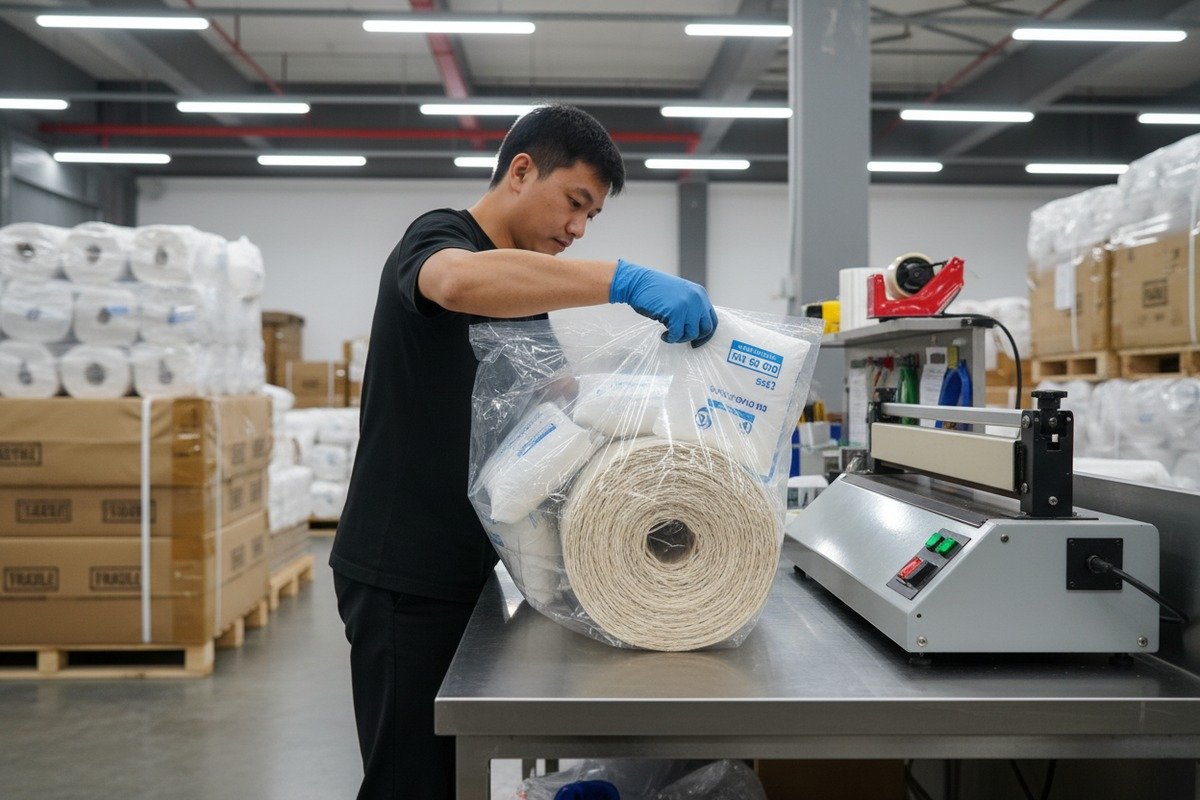
Third, individual roll wrapping matters. Each roll should get a layer of stretch film 6 directly against the material, then a layer of kraft paper or bubble wrap. The film stops surface abrasion. The paper absorbs minor moisture and adds padding.
Rolling Tightness and Direction
Rolling direction is something many buyers overlook. Rattan webbing has a natural curl based on its weave pattern. Rolling against that curl creates tension that can cause edge lifting and eventual fraying. Our production team always rolls with the grain of the weave to maintain a smooth, tight coil.
| Factor | Correct Practice | Common Mistake |
|---|---|---|
| Rolling core | Rigid cardboard or PVC tube | No core, loose folding |
| Edge protection | Tape or heat-seal all cut edges | Leaving raw cut edges exposed |
| Inner wrap | Stretch film tight against roll | Loose plastic bag |
| Outer wrap | Kraft paper or bubble wrap | No secondary layer |
| Rolling direction | With the natural curl of the weave | Against the weave grain |
| Roll tightness | Firm and even, no gaps between layers | Loose rolling with air pockets |
Full Rolls vs. Cut Pieces
Buying full 15-meter rolls gives you a natural advantage. The edges are factory-finished, and the bulk packaging is designed for that exact size. Cut pieces — say, a 2-meter section from a 60cm-wide roll — have two extra exposed edges. If you must order custom cuts, insist that your supplier tapes or wraps each piece individually. Some of our clients request on-demand cutting only after the roll passes quality inspection, and we wrap cut sections in tissue paper before filming. This small step has reduced fraying complaints by over 80% for our cut-piece orders.
A pre-packaging inspection is also critical. Before any wrapping begins, check for loose strands, uneven edges, or minor breaks in the weave. Reinforce weak spots with a dab of wood glue or extra tape. Catching problems before packing is far cheaper than dealing with damaged goods after a three-week ocean voyage.
What packaging standards should I demand from my supplier to protect my bulk rattan rolls?
When we ship container loads of rattan cane webbing to wholesalers in the Netherlands, Australia, or Saudi Arabia, packaging is never an afterthought. It is the last line of defense between your investment and the harsh reality of international logistics 7. Yet many buyers accept whatever packaging their supplier offers by default, and that is where problems begin.
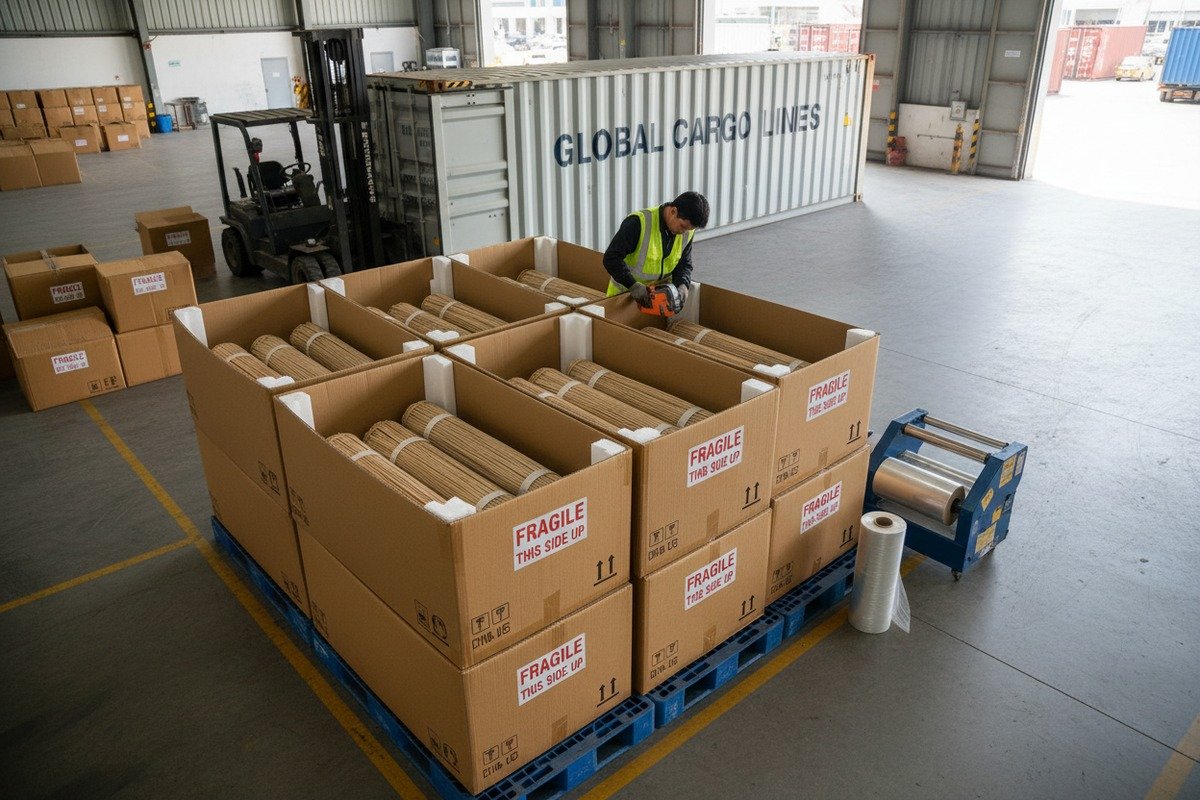
Demand that your supplier uses multi-layer packaging: stretch film directly on each roll, kraft paper or bubble wrap as a secondary layer, rigid cardboard boxes or wooden crates for outer protection, void fillers inside every box, and clear "Fragile" and "This Side Up" labels on all outer surfaces.
The Multi-Layer Packaging System
Think of proper rattan packaging as an onion — multiple protective layers, each serving a specific purpose. Multi-Layer Packaging System 8 The innermost layer (stretch film) prevents abrasion and minor moisture contact. The middle layer (kraft paper, bubble wrap, or foam sheet) absorbs shock and cushions against impacts. The outer layer (cardboard box or wooden crate) provides structural rigidity and stacking resistance.
At our facilities, we follow a standard protocol for all B2B orders. Every roll gets filmed, wrapped, and boxed before it goes onto a pallet. The pallet itself is wrapped in additional stretch film and corner-protected with cardboard angles.
Packaging Standards Comparison
| Packaging Element | Basic Standard | Professional Standard | Premium Standard |
|---|---|---|---|
| Inner wrap | Single plastic bag | Stretch film, tight | Stretch film + tissue paper |
| Middle wrap | None | Kraft paper | Bubble wrap + foam sheet |
| Outer container | Thin cardboard box | Double-wall cardboard box | Wooden crate |
| Void filling | None | Crumpled kraft paper | Custom foam inserts |
| Labeling | Shipping label only | Fragile + orientation labels | Fragile + orientation + humidity indicator |
| Pallet protection | Basic wrap | Corner guards + wrap | Corner guards + strapping + wrap |
What to Include in Your Supplier Agreement
Do not leave packaging to verbal promises. Put your requirements in writing. Specify the following in your purchase order or supplier agreement:
- Material per layer. State exactly what materials you expect — stretch film, bubble wrap, double-wall cardboard, etc.
- Box dimensions. Boxes should fit the rolls snugly. Too much empty space allows shifting. Too tight risks compression.
- Void fill type. Require kraft paper, air pillows, or foam. Never accept empty space inside a box.
- Labeling requirements. "Fragile," "This Side Up," and "Keep Dry" are minimum labels.
- Photo documentation. Ask your supplier to photograph each stage of packing. This creates accountability and evidence if a claim arises.
Why Professional Packaging Is a Selling Point
Many suppliers — including our own brand, Seafan Rattan — now treat packaging quality as a competitive advantage. In the age of e-commerce and platform selling, buyers on Alibaba and direct websites compare not just price per meter, but the quality of delivery. A supplier who invests in proper film-covered rolls with kraft wrapping signals reliability. It tells you they understand the product and the journey it must survive.
For buyers serving the DIY furniture restoration market, damaged goods lead to negative reviews and returns. The cost of professional packaging is a fraction of the cost of replacing a ruined order. Insist on it from day one.
How do I prevent moisture and mold from damaging my rattan materials during sea freight?
Moisture is the silent destroyer of rattan shipments. Our team in Indonesia learned this lesson the hard way years ago when a container of premium radio-weave webbing arrived in Spain covered in white mold. The container had traveled through the tropics for 18 days, and condensation inside the steel box had soaked through inadequate wrapping. That single incident cost thousands of dollars and reshaped how we approach every humid-route shipment.
Prevent moisture and mold damage by ensuring rattan is properly kiln-dried to below 12% moisture content before packing, using desiccant packs inside each box, wrapping rolls in breathable waterproof covers, and avoiding sealed plastic-only packaging that traps condensation during temperature fluctuations at sea.
Understanding Rattan's Hygroscopic Nature
Rattan is hygroscopic. Hygroscopic Nature 9 It absorbs and releases moisture from the air around it. This is actually a useful property — it is why rattan furniture "breathes" and stays comfortable. But during shipping, this property becomes a liability. Inside a sealed steel container, temperature drops at night cause moisture in the air to condense on surfaces. Rattan absorbs this water. If it cannot dry out, mold spores activate and spread within days.
The risk is highest on routes that cross the equator or pass through humid tropical zones. Shipments from Southeast Asia to Europe, the Americas, or the Middle East often face this challenge.
The Drying Process Before Shipping
Proper drying is the first and most important defense. At our rattan processing facility in Indonesia, we use modern kiln-drying machinery to bring moisture content below 12%. Some traditional suppliers still air-dry their rattan, which is slower and less consistent. Air-dried material may look dry on the surface but retain internal moisture that feeds mold growth weeks later.
| Drying Method | Target Moisture Content | Consistency | Mold Risk | Time Required |
|---|---|---|---|---|
| Kiln drying (modern) | 8–12% | High, uniform | Low | 24–48 hours |
| Air drying (traditional) | 14–18% | Variable, uneven | Medium to high | 5–14 days |
| Sun drying (basic) | 12–20% | Very uneven | High | 3–7 days |
Breathable vs. Sealed Packaging
Here is a counterintuitive point that trips up many buyers: sealing rattan in airtight plastic can actually cause more mold, not less. If the rattan has even slight residual moisture, airtight wrapping traps that moisture against the material. With no air circulation, the humidity inside the bag rises quickly.
The solution is breathable waterproof covers. These specialized materials block liquid water from the outside (like container condensation dripping down) but allow water vapor to escape from the inside. Think of it like a rain jacket for your rattan — keeps the rain out, lets the sweat escape.
Desiccant Packs and Humidity Indicators
Place silica gel desiccant packs inside each box. For a standard roll of 15 meters by 60 centimeters, we include two to three 100-gram desiccant packs. These absorb excess moisture inside the packaging and create a drier micro-environment around the rattan.
Humidity indicator cards are a newer tool we have started including for premium clients. These small cards change color based on the humidity level inside the box. When the buyer opens the shipment, they can immediately see if moisture levels stayed safe during transit. It is a simple, inexpensive quality assurance tool.
Post-Arrival Care
Even with perfect shipping preparation, buyers should inspect rattan immediately upon arrival. Unbox the rolls and allow them to air out in a clean, dry space for 24 to 48 hours. If you notice any musty smell or surface dampness, spread the webbing flat and use a fan to circulate air around it. Applying a light coat of linseed oil or specialized rattan oil after the material has fully dried can restore flexibility and add a moisture-resistant layer for storage.
For buyers in humid climates like Thailand or the Philippines, long-term storage should be in climate-controlled or at least well-ventilated warehouses. Stacking rolls directly on a concrete floor is risky — use pallets or shelving to keep materials off the ground.
What steps can I take to minimize the risk of crushing or structural damage to my cane webbing order?
Crushing damage is especially painful because it is often irreversible. A moldy roll can sometimes be cleaned and salvaged. A crushed roll with permanent creases and broken strands is scrap. Our logistics team tracks damage reports across all export markets, and crushing accounts for roughly a third of all shipping claims we see industry-wide. The cause is almost always poor stacking, inadequate outer packaging, or zero internal support.
Minimize crushing and structural damage by using rigid outer crates or double-wall boxes, never stacking heavy cargo on top of rattan, using custom-fit internal bracing or foam inserts, distributing weight evenly on pallets, and ensuring correct orientation with clear "This Side Up" labels throughout the supply chain.
How Crushing Happens in a Container
A standard 20-foot shipping container holds about 33 cubic meters of cargo. In a full container load (FCL), your rattan rolls might share space with heavier goods — ceramic tiles, metal hardware, or stacked furniture components. Even in a container dedicated to rattan, the bottom rolls bear the weight of everything above them.
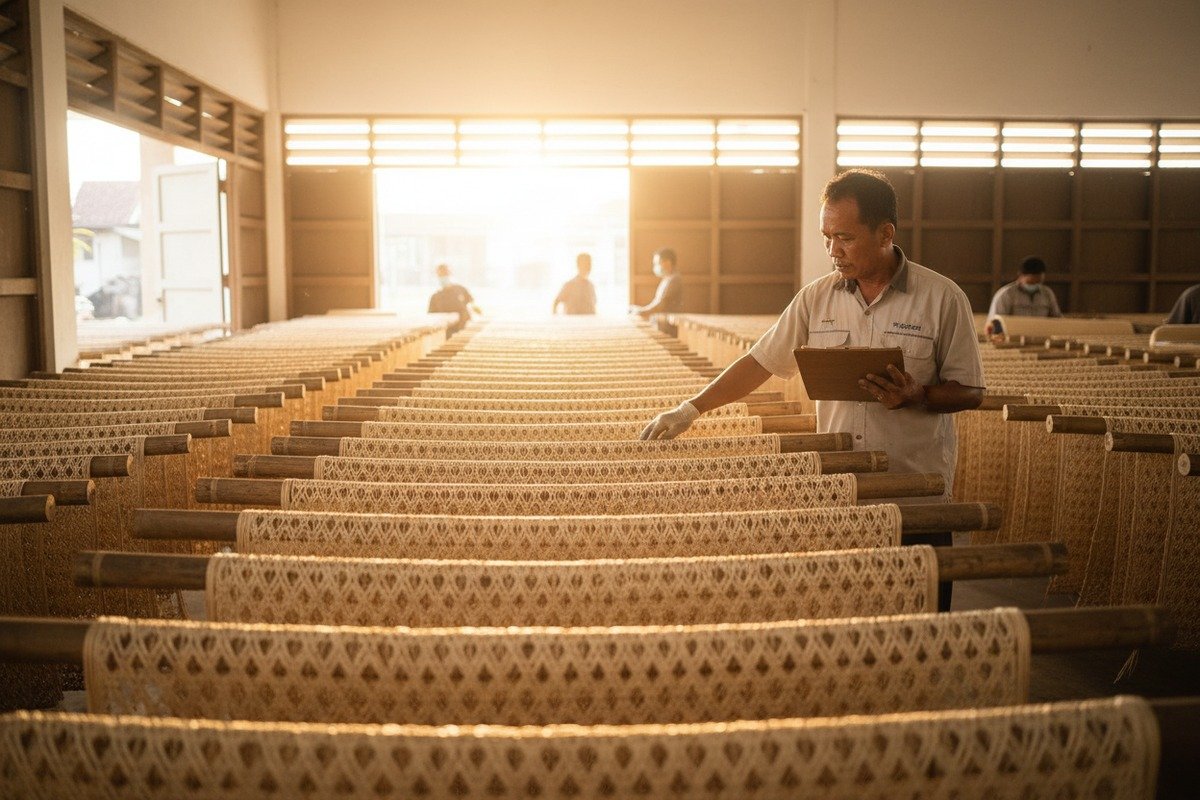
During transit, the ship rolls and pitches. Cargo shifts. Straps loosen. A 50-kilogram box that was sitting safely on a shelf slides sideways and lands on your carefully packed rattan. Without rigid outer protection, the webbing deforms. The delicate weave — whether it is a hexagonal radio pattern or a tight basketweave — gets crushed, and the strands break at the stress points.
Structural Protection Methods
There are several layers of defense against crushing:
Rigid outer packaging. Double-wall cardboard boxes are the minimum for rolls up to 60cm wide. For wider rolls (90cm–120cm) or high-value orders, wooden crates offer far superior protection. The crate acts like a skeleton, maintaining its shape even under significant external pressure.
Internal bracing. Custom foam inserts or corrugated cardboard dividers inside the box prevent the roll from moving. The roll should fit snugly but not be compressed. Think of it like a cradle — the insert supports the roll's natural shape from all sides.
Pallet loading strategy. Rattan rolls should be positioned on pallets with the heaviest and most rigid packages on the bottom. Rattan goes on top or in the middle, never at the base of a stack. Each pallet should be strapped, corner-guarded, and wrapped.
Weight Distribution and Stacking Limits
| Roll Width | Recommended Outer Packaging | Max Stacking Layers | Pallet Position |
|---|---|---|---|
| 40–45 cm | Double-wall cardboard box | 4 layers | Top or middle |
| 60 cm | Double-wall cardboard box | 3 layers | Top or middle |
| 90 cm | Wooden crate or reinforced box | 2 layers | Top only |
| 120 cm | Wooden crate | 1 layer (no stacking) | Top only |
The Role of Labeling
Labeling is simple, cheap, and often ignored. A clearly printed "Fragile" label, a "This Side Up" arrow, and a "Do Not Stack" warning will not guarantee gentle handling. But they significantly improve the odds. Freight handlers process hundreds of packages per shift. A visible label catches attention and communicates the need for care in a universal language.
We print labels on at least three sides of every box — the top and two visible faces once palletized. For wooden crates, we stencil warnings directly onto the wood so they cannot peel off.
Pre-Shipping Conditioning for Structural Integrity
In very dry climates or during winter months, rattan can become brittle. Brittle rattan cracks under pressure that flexible rattan would absorb without damage. A light misting — not soaking — before packing restores just enough pliability to survive the bumps of transit. This is especially relevant for natural rattan; synthetic rattan (plastic cane) does not have this issue, as its flexibility is built into the polymer.
However, there is a fine balance. Too much moisture before packing introduces the mold risks we discussed earlier. The goal is to bring the rattan to a balanced state — not bone-dry, not damp. Our production staff uses handheld moisture meters to check every roll before it goes to the packing line.
Natural vs. Synthetic: A Structural Comparison
Natural rattan, especially premium Indonesian rattan with plump, strong poles, offers excellent elasticity and breathability. It bends without breaking under moderate stress. But it is organic, which means it degrades over time and reacts to environmental conditions.
Synthetic rattan, made from durable plastic that mimics natural wood fibers, skips many of these concerns. It does not absorb moisture, does not mold, and maintains consistent flexibility regardless of climate. However, it can still be permanently deformed by crushing if packaging is inadequate. And for many buyers, it lacks the authentic texture and eco-friendly appeal of real cane.
The choice between natural and synthetic should factor in your shipping route, storage conditions, and end-customer expectations. Both require proper packaging. Neither is immune to damage from negligence.
Conclusion
Protecting rattan cane webbing during shipping comes down to preparation, proper packaging, moisture control, and smart loading. Every step matters — from kiln-drying and edge-taping at the factory to desiccant placement 10 and stacking strategy in the container. Work closely with your supplier, put packaging standards in writing, and inspect every shipment on arrival. Your rattan deserves to arrive as beautiful as the day it left the loom.
Footnotes
1. Provides a comprehensive overview of rattan, its origin, and uses. ↩︎
2. Explains how moisture barrier materials work and their importance in packaging. ↩︎
3. Describes rattan’s natural properties as an organic, fibrous material. ↩︎
4. Discusses dynamic forces and vibrations causing cargo damage during sea transport. ↩︎
5. Explains the benefits of plastic packaging cores, including PVC, for durability and moisture resistance. ↩︎
6. Found a comprehensive guide on stretch film, its types, and uses in packaging. ↩︎
7. Discusses the complexities, challenges, and best practices in international logistics. ↩︎
8. Found an authoritative Wikipedia article explaining multilayered packaging. ↩︎
9. Defines hygroscopy and explains how materials attract and hold water molecules. ↩︎
10. Found a relevant article on proper desiccant placement in shipping containers. ↩︎

 English
  Español de México
  العربية
  Deutsch
  Français
  Русский