
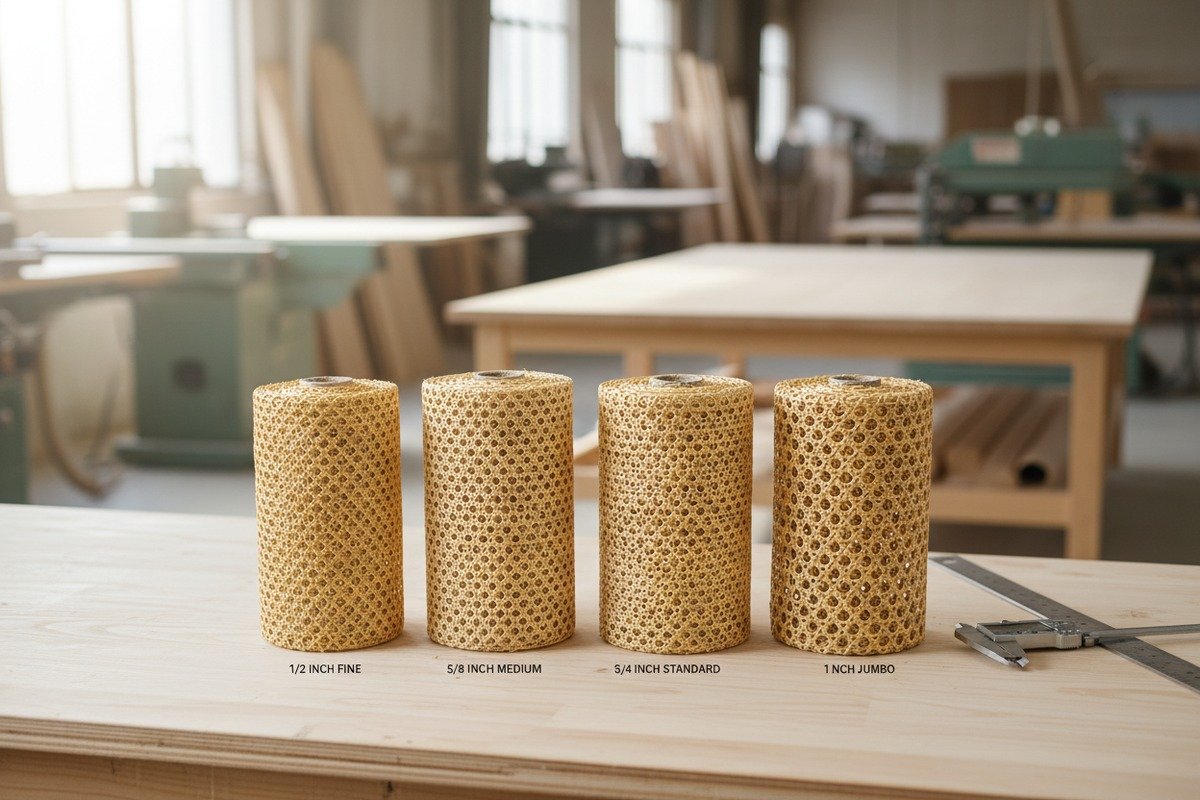
Every week, our sales team at Seafan Rattan fields dozens of inquiries from furniture factories and wholesalers confused about mesh size labels UV treatment 1. The problem is real: order the wrong mesh size, and your entire production run stalls. Wasted material. Delayed shipments. Frustrated clients. Understanding how mesh sizes are categorized is the first step to avoiding these costly mistakes.
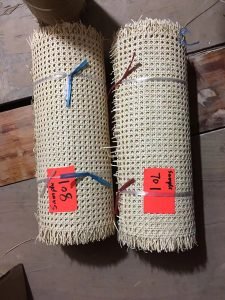
Rattan cane webbing mesh sizes are categorized primarily by the center-to-center hole spacing, measured in fractions of inches—commonly 1/2″ (fine), 5/8″ (medium), 3/4″ (standard), and 1″ (jumbo). Additional categorization factors include weave pattern, roll width, material type, and quality grade.
In this guide, we break down every factor that defines mesh size categories. Whether you run a furniture factory or manage wholesale procurement, you will find clear answers, practical tables, and buying tips below.
How do I accurately measure rattan cane webbing mesh sizes for my furniture production?
Mismeasured mesh is one of the top reasons our clients receive webbing that does not fit their groove channels. A single misreading can throw off an entire batch of chairs or cabinet panels.
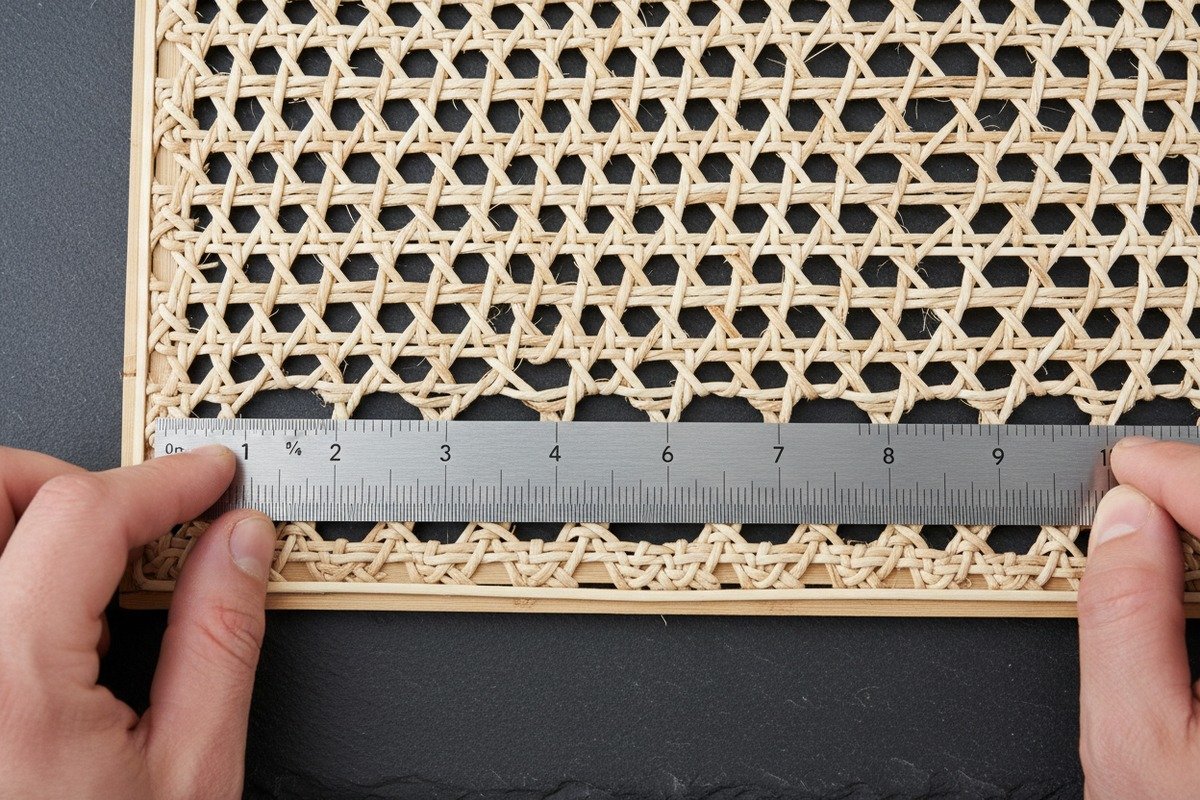
To accurately measure rattan cane webbing mesh size, place a ruler across the webbing and measure from the center of one hole to the center of the adjacent hole. This center-to-center distance—expressed in fractions of inches like 1/2", 5/8", 3/4", or 1"—defines the mesh size category of the webbing.
The Center-to-Center Method
This is the industry standard. You do not measure the hole itself. You do not measure the cane strand width. You measure from the middle of one opening to the middle of the next opening. Use a rigid metal ruler, not a flexible tape. Lay the webbing flat on a hard surface. Count at least five holes to get a reliable average.
Many beginners make the mistake of measuring the hole diameter alone. That number tells you nothing about the mesh category. Two webbing rolls can have identical hole diameters but different mesh sizes because the strand thickness varies. Center-to-center is the only measurement that matters for categorization.
Understanding the Four Standard Mesh Sizes
Here is a quick reference table we share with every new client:
| Mesh Size | Center-to-Center | Common Name | Typical Use |
|---|---|---|---|
| 1/2" | 12.7 mm | Fine mesh | Detailed chair backs, small panels |
| 5/8" | 15.9 mm | Medium mesh | Cabinet doors, headboards |
| 3/4" | 19.1 mm | Standard / Traditional | Chair seats, room dividers |
| 1" | 25.4 mm | Jumbo mesh | Large decorative panels, screens |
Fine mesh (1/2") produces a tighter weave with less visibility through the panel. Jumbo mesh (1") creates an open, airy look. Most of the orders we process at our Foshan warehouse fall in the 1/2" to 3/4" range, because those sizes suit the widest variety of furniture styles.
Measuring for Grooved Seat Installation
If your furniture uses a groove-and-spline system, you need more than just the mesh size. You also need to calculate how much webbing to order. The formula is simple:
- Measure the groove length in inches. Add 4 inches.
- Measure the groove width in inches. Add 4 inches.
- Convert both numbers to feet by dividing by 12.
The extra 4 inches on each side provides the 2-inch overlap needed to press the webbing into the groove with a spline. We always recommend ordering at least one extra foot per dimension to account for trimming waste.
Roll Width and Length Standards
Mesh size is only one dimension. You also need to specify the roll width and length. Widths typically come in standard increments:
| Width (inches) | Width (cm) | Availability |
|---|---|---|
| 12" | 30 cm | Common |
| 18" | 45 cm | Very common |
| 24" | 60 cm | Very common |
| 36" | 90 cm | Common |
| 48" | 120 cm | Less common |
| 72" | 180 cm | Custom order |
Natural rattan 2 rolls usually come in 50-foot (15-meter) lengths for widths up to 60 cm. Wider rolls—over 110 cm—are often limited to 33-foot (10-meter) lengths because the natural cane is harder to process at wider dimensions. Synthetic rattan can run up to 100 feet (30 meters) per roll, which makes it popular for large-scale production lines.
Which mesh size should I choose to ensure the best durability for my chair designs?
Over the years, our production team has tested thousands of webbing panels under load. We have seen what breaks first and what lasts longest. Choosing the wrong mesh size for a chair is not just an aesthetic mistake—it is a structural one.
For maximum durability in chair seats and backs, a 1/2" or 5/8" fine-to-medium mesh is recommended because the tighter weave distributes body weight across more cane strands, reducing stress per strand. Larger mesh sizes like 1" are better suited for decorative panels that bear no load.

How Mesh Size Affects Load Distribution
Think of mesh size like a net. A net with many small openings catches weight evenly. A net with fewer, larger openings concentrates weight on fewer strands. The same principle applies to rattan webbing on a chair seat.
With a 1/2" mesh, more cane strands cross per square inch. Each strand carries a smaller share of the sitter's weight. This reduces the chance of individual strands snapping or stretching over time. A 1" jumbo mesh looks striking on a decorative screen, but on a dining chair seat it sags faster because fewer strands do all the work.
Weave Pattern Matters Too
Mesh size alone does not tell the full durability story. The weave pattern 3 also plays a critical role. Here are the most common patterns and their durability profiles:
| Weave Pattern | Description | Durability for Seating | Best Use |
|---|---|---|---|
| Octagonal (Open Mesh) 4 | Classic hexagonal/octagonal holes | Good (with fine mesh) | Traditional chairs, cabinet inserts |
| Square / Radio Weave | Uniform square grid | Very good | Chair seats, headboards |
| Herringbone 5 | Zigzag pattern with 2–3 mm strands | Excellent | High-end chair seats, modern furniture |
| Close Weave (3×3 mm) | Dense, no visible holes | Excellent | Heavy-use seating, outdoor |
| X-Factor | Flat reed overlays on 1/2" mesh | Good | Decorative panels, cabinet doors |
Square weave and herringbone patterns tend to outperform open octagonal weaves in durability tests. The reason is simple: their strand crossings are more uniform, and force transfers more evenly across the panel.
Material Type and Grade
Natural rattan graded AAA or Grade A has the most consistent strand thickness and fewer weak spots. Lower grades (B, C, D) may have thinner sections, knots, or color variation that create stress points. When durability matters—like for dining chairs used daily—we always recommend Grade A natural rattan or higher.
Synthetic rattan (PE-based) 6 offers superior weather resistance and will not crack in humid or dry conditions. However, it lacks the natural elasticity that allows real rattan to absorb shock loads. For indoor chairs, natural Grade A rattan in a fine mesh is the gold standard. For outdoor chairs, synthetic rattan in a close or square weave pattern wins.
Practical Tips from Our Factory Floor
We advise clients to request a sample panel before committing to a large order. Mount the sample on a test frame. Apply pressure with your hand or a weight. Listen for cracking. Check for strand separation. A good webbing panel should flex slightly and return to shape. If it stays deformed, the mesh is too open or the grade is too low for seating.
Also consider the spline and groove depth. A shallow groove with a thin spline will fail before the webbing does, no matter how fine the mesh. Durability is a system—mesh size, weave pattern, material grade, and installation method all work together.
How does the categorization of mesh sizes affect the wholesale pricing of my order?
When we prepare quotations for our wholesale buyers, the mesh size category is one of the first variables that shifts the price. Many purchasing managers assume price depends only on roll dimensions. That assumption leads to budget surprises.
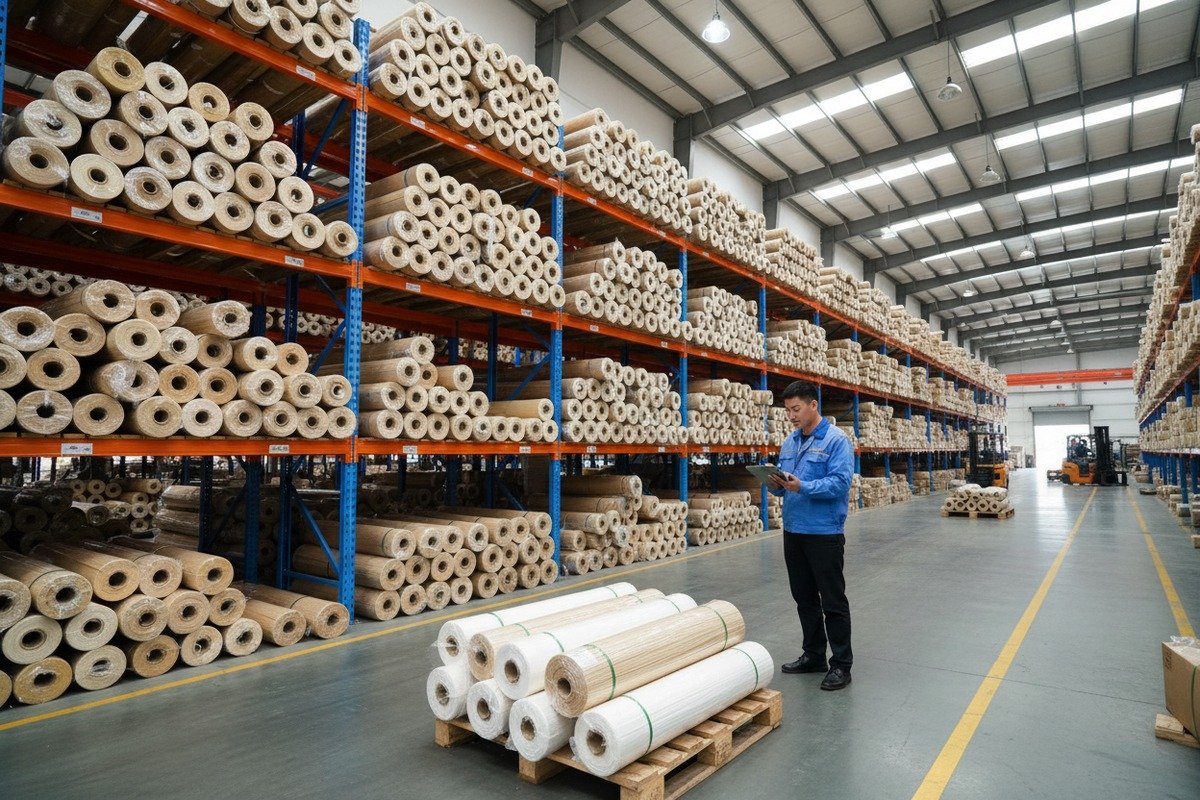
Mesh size categorization directly affects wholesale pricing because finer meshes require more raw cane material per square meter, longer weaving time, and higher labor costs. A 1/2" fine mesh typically costs 15–30% more than a 1" jumbo mesh in the same material grade and roll dimensions.
Why Finer Mesh Costs More
The logic is straightforward. A 1/2" mesh has roughly four times as many strand crossings per square foot as a 1" mesh. That means:
- More raw material. Each square meter of fine mesh uses more rattan cane by weight.
- Longer production time. Our weaving machines run slower for tighter patterns. Hand-woven options take even longer.
- Higher waste rates. Fine mesh is less forgiving of strand defects. More cane gets rejected during quality inspection.
These factors stack up. For a 50-foot roll of 24"-wide natural rattan, the price difference between 1/2" and 1" mesh can be significant enough to reshape your production budget.
Price Factors Beyond Mesh Size
Mesh size is just one piece of the pricing puzzle. Here are the other variables that interact with it:
| Pricing Factor | Impact on Cost | Notes |
|---|---|---|
| Mesh size | 15–30% range | Finer = more expensive |
| Material (natural vs. synthetic) | 10–40% range | Natural Grade A costs more than synthetic |
| Quality grade 7 (AAA, A, B, C) | 20–50% range | AAA commands premium pricing |
| Weave pattern | 5–20% range | Herringbone and X-Factor cost more than octagonal |
| Roll width | Variable | Wider rolls (48"+) may have surcharges |
| Order volume | 5–15% discount | Larger orders unlock better unit prices |
| Color / finish | 5–15% range | Bleached or stained adds processing cost |
Volume Discounts and Mesh Selection Strategy
From our experience shipping to the Netherlands, the US, Australia, and the Middle East, the smartest buyers plan their mesh selection around volume. If you can standardize on one or two mesh sizes across your product range, you consolidate your order into higher volumes per SKU. That unlocks better per-foot pricing.
For example, one of our regular clients in Thailand uses 5/8" medium mesh for both dining chairs and cabinet panels. By ordering a single mesh size in bulk, they save roughly 12% compared to splitting the order across three different mesh sizes. The lesson: fewer mesh size variations in your catalog means stronger negotiating power with your supplier.
Hidden Costs to Watch
Some buyers focus only on the per-foot price and overlook shipping weight. Fine mesh webbing is heavier per roll because it contains more material. That extra weight adds to freight costs, especially for sea shipments priced by volume or weight. Ask your supplier for the weight per roll, not just the price per foot.
Packaging also matters. At Seafan Rattan, we use reinforced cardboard tubes and shrink-wrap to protect rolls during transit. Cheaper packaging saves a few dollars upfront but can lead to crushed or moisture-damaged rolls. The cost of replacing a damaged shipment always exceeds the savings on packaging.
Can I request custom mesh dimensions to match my specific Grade A quality standards?
Many of our long-term clients started with standard sizes. Over time, their product lines evolved. They needed a 9/16" mesh instead of 5/8". Or a 28-inch width that no catalog listed. These requests come to our production planning desk every month.
Yes, custom mesh dimensions are available from established suppliers like Seafan Rattan. You can specify exact center-to-center spacing, roll widths up to 72 inches, unique weave patterns, and Grade A or higher quality standards—provided the order meets the supplier's minimum quantity requirement, typically one full production run.
What Can Be Customized?
Almost every parameter is adjustable when you work directly with a manufacturer that controls its own weaving facility. Here is what our clients commonly customize:
- Mesh size. Any center-to-center spacing between 3/8" and 1-1/4". Non-standard increments like 9/16" or 7/8" are possible.
- Roll width. Standard widths from 12" to 48" are always in stock. Custom widths up to 72" (180 cm) require a dedicated production run.
- Roll length. Natural rattan rolls can be produced in 10-foot to 50-foot lengths. Synthetic rolls can extend to 100 feet.
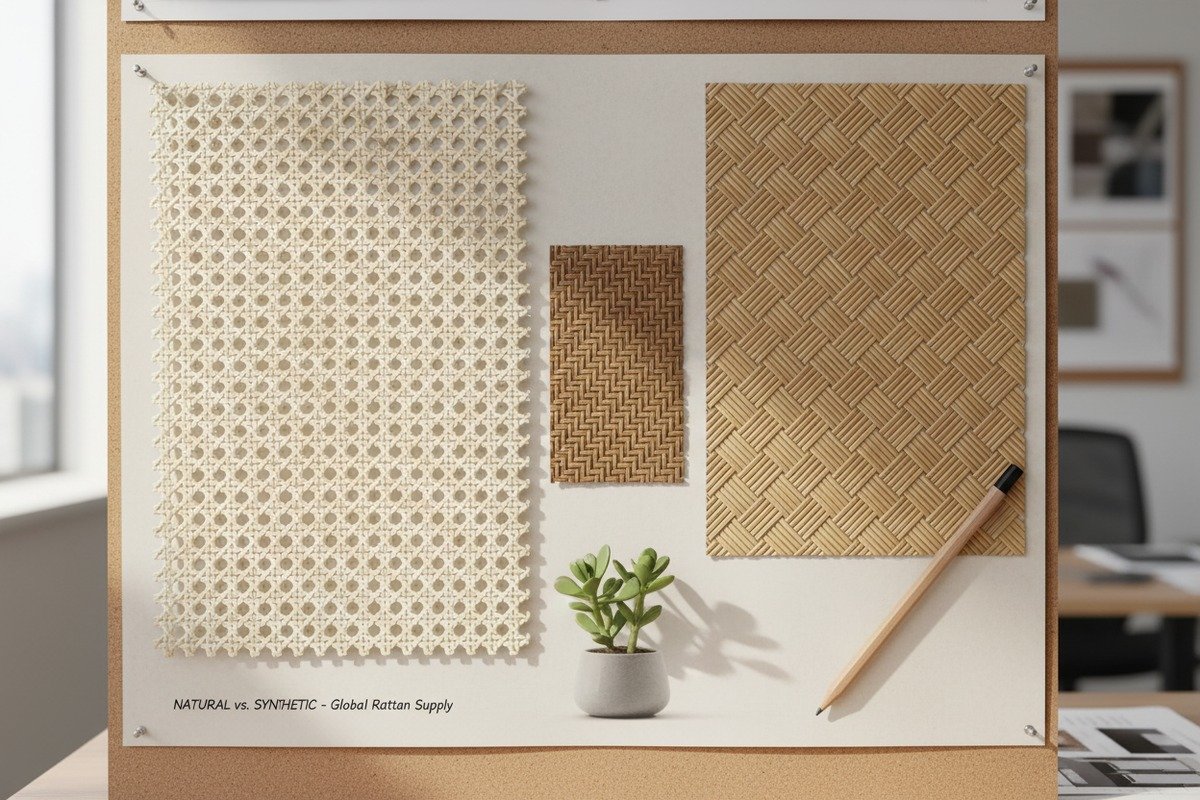
- Weave pattern. Octagonal, square, herringbone, X-Factor, close weave, or even digitally designed patterns for modern aesthetics.
- Material. Natural rattan (Grade AAA, A, B), synthetic PE rattan, paper, or cotton blends.
- Color and finish. Natural, semi-bleached, fully bleached, stained, or UV-treated for outdoor use.
Minimum Order Quantities for Custom Work
Custom production is not free. Retooling a weaving machine for a non-standard mesh size takes time. Our factory typically requires a minimum of 200–500 linear meters for a custom mesh size order. For custom widths above 48", the minimum may be higher because the machine setup is more complex.
If your order is smaller, consider whether a standard mesh size can work with minor adjustments to your furniture design. We often help clients find the closest standard option that meets their needs without triggering custom production minimums.
Matching Grade A Quality Standards
Grade A quality means consistent strand thickness, minimal color variation, no knots or breaks, and smooth texture across the entire roll. When you request custom dimensions at Grade A level, three things happen:
- Raw material selection tightens. Only the top tier of harvested rattan cane enters the production line. Lower-quality strands are sorted out.
- Inspection frequency increases. Our quality team checks every 5 meters instead of every 15 meters.
- Rejection rates climb. More rolls fail inspection, which increases the effective cost per accepted roll.
This is why Grade A custom orders cost more than Grade B or C custom orders at the same dimensions. You are paying for consistency and reliability, not just the physical webbing.
Sustainability and Certification
An emerging factor in custom orders is sustainability certification 8. Some European and Australian buyers now require proof that rattan is responsibly harvested. Our Indonesian processing facility follows sustainable harvesting protocols, and we can provide documentation for buyers who need it. This does not change the mesh size itself, but it adds a layer of categorization—certified versus non-certified—that affects procurement decisions.
Fire Retardancy and UV Treatment
For commercial projects—hotels, restaurants, public buildings—custom webbing may need fire retardancy 9 treatment to meet local safety codes. UV treatment is essential for any outdoor application. Both treatments are applied after weaving and before shipping. They add cost but do not alter the mesh dimensions. Make sure to specify these requirements at the quotation stage, not after production begins.
Conclusion
Rattan cane webbing mesh sizes are categorized by center-to-center hole spacing 10, weave pattern, material type, quality grade, and roll dimensions. Understanding these categories helps you order accurately, control costs, and deliver durable furniture to your customers. Reach out to our team at Seafan Rattan for samples and pricing tailored to your exact specifications.
Footnotes
1. Defines UV protection in architecture and discusses materials and methods used for safeguarding against UV radiation. ↩︎
2. Provides a comprehensive overview of natural rattan material, its definition, origin, and properties. ↩︎
3. Explains different methods of interlacing threads or strands in textiles. ↩︎
4. Describes various fabric weave patterns, including open weave types. ↩︎
5. Defines the distinctive V-shaped weaving pattern known as herringbone. ↩︎
6. Offers a detailed explanation of PE rattan, including its definition, types, production process, and benefits. ↩︎
7. Provides a general definition of ‘quality grade’ applicable to various products and materials. ↩︎
8. Highlights initiatives and standards for sustainable rattan production. ↩︎
9. Explains what flame retardants are and how they work to inhibit or delay combustion. ↩︎
10. Provides a general definition of center-to-center measurement. ↩︎
 English
  Español de México
  العربية
  Deutsch
  Français
  Русский