

Every week on our production floor, we see rolls of rattan cane webbing ship out to lighting factories worldwide—and the creative applications never stop surprising us.
Natural rattan cane webbing can be used creatively in lighting design by wrapping it around pendant frames, crafting drum lampshades, layering different weave densities for shadow play, stitching it onto metal sconce structures, and integrating it with LED strips to produce warm, diffused, and organic ambient light effects.
Rattan lighting is booming. From boho pendants on Etsy to high-end hotel chandeliers, designers are turning to this renewable material for texture, warmth, and sustainability. Below, we break down how to use different patterns for shadow effects, how to source export-quality webbing, the best application techniques, and where to buy Grade A cane webbing in bulk.
How can I use different rattan cane webbing patterns to create unique shadow effects in my lighting designs?
When we first started supplying webbing to lighting designers in the Netherlands and Australia, we noticed they obsessed over one thing above all else—shadow patterns on the ceiling and walls.
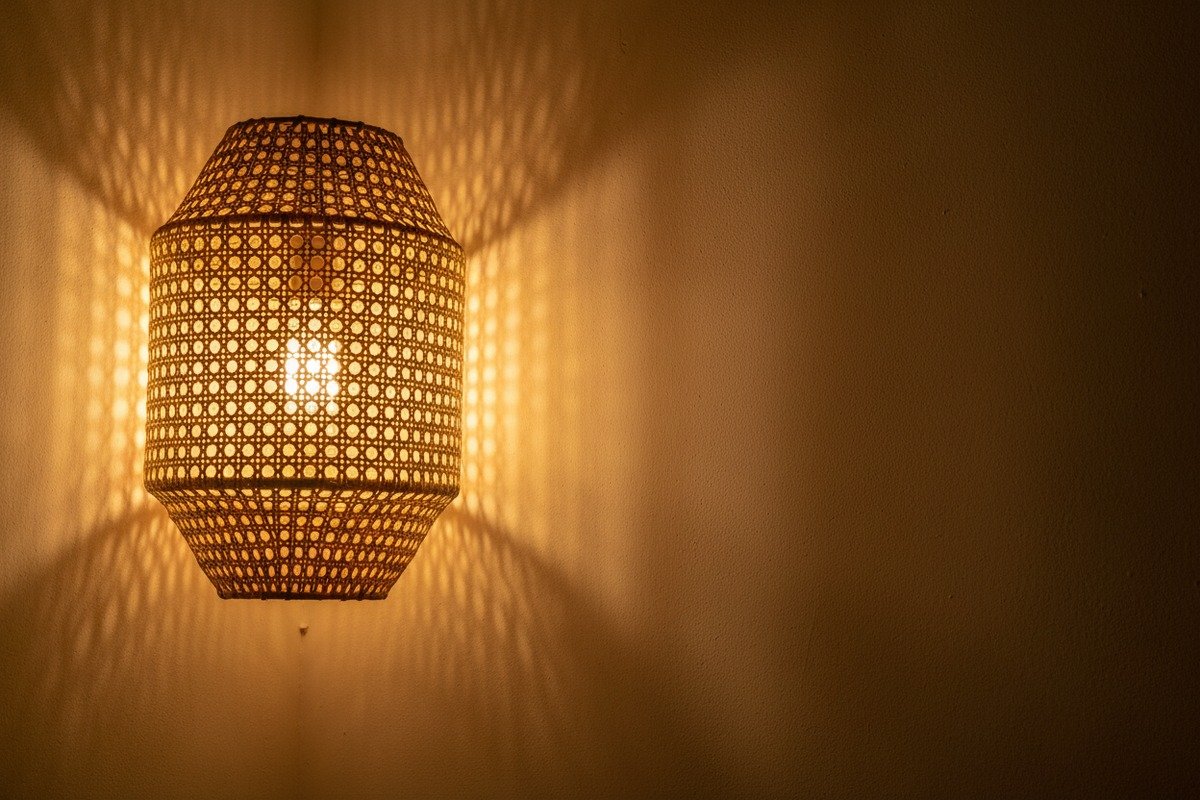
You can create unique shadow effects by selecting specific weave patterns—open hexagonal for large geometric shadows, tight basketweave for subtle texture, and diamond-motif weaves for intricate starbursts—then pairing each pattern with the right bulb type and placement inside the fixture.
Understanding How Weave Density Controls Light
The key principle is simple. Tighter weaves block more light and cast softer, more diffused shadows. Open weaves let more light through and project sharper, more defined patterns onto surrounding surfaces.
Think of the webbing as a stencil. The bulb is your projector. The wall is your canvas. Change any one variable—weave density 1, bulb position, or distance to the wall—and the shadow art changes completely.
In our experience shipping to designers across 15+ countries, the most popular patterns for lighting fall into a few clear categories. Here is how they compare:
| Weave Pattern | Shadow Effect | Best Use Case | Light Diffusion Level |
|---|---|---|---|
| Open Hexagonal | Large honeycomb shapes on walls | Pendant lights, ceiling fixtures | Low (sharp shadows) |
| Tight Basketweave | Soft, even glow with minimal pattern | Drum lampshades, table lamps | High (gentle diffusion) |
| Diamond Motif | Starburst or lattice patterns | Statement pendants, chandeliers | Medium |
| Open Square Grid | Clean, geometric lines | Modern/minimalist sconces | Low to Medium |
| Radio Weave (Sunburst) | Radiating lines from center | Round pendant globes | Medium |
Choosing the Right Bulb for Maximum Shadow Play
Not all bulbs work the same way behind rattan webbing. A single-point filament bulb, like an Edison-style bulb 2, creates the crispest shadows because the light source is small and concentrated. An LED panel or frosted globe bulb spreads the light source wider, which softens shadows and reduces pattern definition.
For dramatic shadow effects, we always recommend a warm-tone Edison bulb (2700K) placed at the center of the fixture. Keep the maximum wattage at 40W or use LED equivalents to avoid heat damage to the cane. Battery-powered LEDs and smart LED strips 3 are safer alternatives, especially for tighter weave patterns where airflow is limited.
Layering Multiple Weave Patterns
One trend we see growing among our European buyers is layering. They use two concentric shades—an inner shade with a tight weave for soft base light, and an outer shade with an open hexagonal weave for strong shadow projection. The result is a layered shadow effect that adds depth and dimension to any room.
You can also cut panels of different weave patterns and stitch them together on a single frame. This patchwork approach creates zones of light and shadow within one fixture. It works especially well on larger drum-style or cylindrical shades.
Practical Tips for Shadow Testing
Before committing to a full production run, test your shadow effects. Hold the webbing sample 15–20 cm from a bare bulb in a dark room. Rotate it. Tilt it. See how the pattern stretches and distorts. This 5-minute test saves hours of rework.
Curved frames amplify shadow distortion. Flat panels keep shadows clean and geometric. Choose your frame shape based on whether you want organic, flowing shadows or crisp, architectural lines.
How do I ensure the natural rattan webbing I source for my lampshades meets high-quality export standards?
From our rattan processing facility in Indonesia to our Foshan headquarters, quality control is something we deal with at every stage—and we know exactly where things can go wrong.
To ensure export-quality rattan webbing, verify the material is Grade A with consistent strand thickness, uniform color tone, no mold or insect damage, proper moisture content below 12%, and clean finished edges—then confirm packaging meets international shipping standards to prevent transit damage.
What Defines Grade A Rattan Cane Webbing
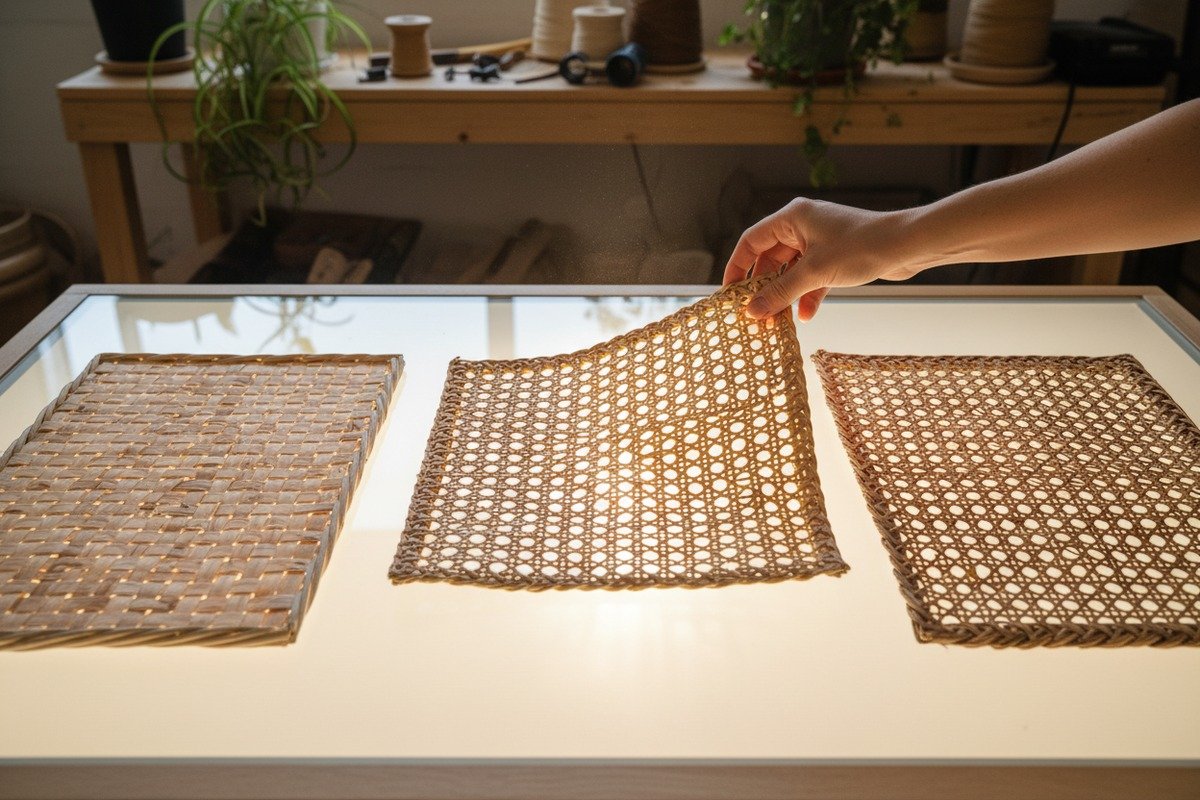
Grade A rattan webbing starts with the raw material. The outer bark of the rattan palm 4—the cane peel—must be harvested from mature vines. Young vines produce thin, brittle cane that cracks easily. Mature vines give thick, flexible strands with a natural golden-yellow tone.
Here are the key quality markers we check on our production line before any batch clears for export:
| Quality Parameter | Grade A Standard | Common Defect |
|---|---|---|
| Strand Thickness | Uniform, 0.4–0.6 mm | Uneven thickness, thin spots |
| Color Tone | Consistent light beige to sandy tan | Dark spots, discoloration, bleach marks |
| Moisture Content 5 | Below 12% | Above 15% leads to mold during shipping |
| Surface Finish | Smooth, no splinters | Rough patches, loose fibers |
| Weave Tension | Even and tight across the roll | Loose weave, gaps, sagging sections |
| Edge Finishing | Clean cut, no fraying | Ragged edges, unraveling strands |
| Insect/Mold Damage | None | Bore holes, black mold spots |
Moisture Content Is the Silent Killer
This is the number one issue we see with buyers who source from unverified suppliers. Rattan is hygroscopic—it absorbs moisture from the air. If the webbing is packed at 18% moisture content in a tropical factory and then sits in a shipping container for 30 days, mold will develop. Every time.
We kiln-dry our webbing to below 12% moisture and pack it with silica gel desiccants 6. We also use moisture-barrier wrapping for all ocean freight shipments. If your current supplier does not provide moisture content certificates, that is a red flag.
Packaging That Survives International Transit
Quality webbing means nothing if it arrives crushed or dented. Rolls should be wrapped individually in protective film, then placed in reinforced cartons with corner protectors. For larger orders, wooden crates or palletized packaging prevents compression damage.
One of the top pain points our purchasing managers mention is packaging durability. We addressed this by developing a triple-layer packaging system: inner plastic wrap, corrugated cardboard tube, and outer carton with strapping. This reduced transit damage claims by over 90% for our US and European customers.
Testing Before Committing to Bulk
Always request samples before placing a bulk order. Check the webbing under direct light for color consistency. Bend a strand—it should flex without cracking. Smell it—musty odor indicates improper drying or early mold. These simple checks take minutes but save thousands in rejected shipments.
What are the best techniques for me to apply rattan webbing to various lighting frame shapes?
Over the years, our team has worked with lighting manufacturers in Spain, Turkey, and the US who each bring different frame designs to the table—cylinders, cones, spheres, and flat panels. Each shape demands a different application technique.
The best techniques include wrapping pre-woven webbing sheets around cylindrical or drum frames with adhesive and staples, darting and stitching webbing onto conical frames, soaking and molding wet cane over spherical molds, and hand-stitching flat panels onto metal sconce frames using jute cord or wire.
Working With Cylindrical and Drum Frames
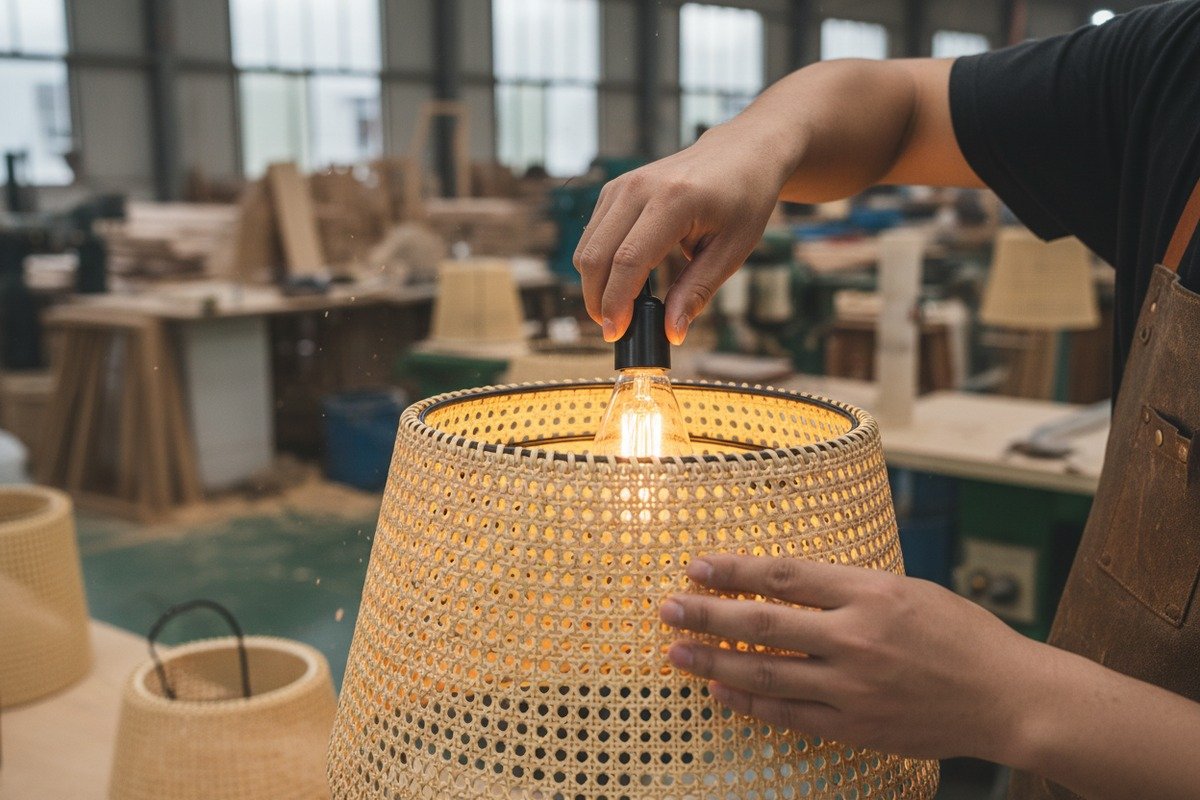
Cylinders are the easiest frame shape for rattan webbing. Cut a rectangle of pre-woven webbing slightly larger than the circumference and height of the frame. Soak the webbing in warm water for 10–15 minutes to make it pliable. Wrap it around the frame, overlapping the seam by about 1 cm. Secure with wood glue along the overlap and use paper clips or small clamps to hold it while drying. Once dry, the webbing tightens and grips the frame.
For a cleaner finish, fold the top and bottom edges inward and glue them against the frame ring. This hides raw edges and prevents fraying over time.
Conical and Tapered Shapes
Cones are trickier. Flat webbing does not naturally conform to a tapered shape without distortion. The solution is darting—cutting small V-shaped wedges out of the webbing so it wraps smoothly around the cone without bunching. Think of it like tailoring fabric to fit a body.
Cut your darts evenly around the circumference. Overlap the dart edges and glue or stitch them closed. The result is a smooth, wrinkle-free conical shade. For larger cones, you may need 6–8 darts. For smaller ones, 3–4 will do.
Spherical and Orb-Shaped Fixtures
Spheres require the most skill. There are two main approaches:
Method 1: Wet Molding. Soak the webbing thoroughly, then press and stretch it over a balloon or spherical mold. Use string or rubber bands to hold it in place as it dries over 24–48 hours. The cane hardens into the curved shape. Remove the mold and trim the edges.
Method 2: Strip Assembly. Cut the webbing into long, narrow strips. Weave or overlap the strips around a wire sphere frame, stitching each strip to the frame with thin wire or jute cord 8. This creates a segmented globe look that is popular in boho and mid-century modern designs.
Flat Panel and Sconce Applications
For wall sconces and flat panel lights, the process is straightforward. Cut the webbing to size. Stretch it across the back of a metal or wooden frame. Staple or glue the edges to the frame's rear face. The webbing sits flat behind the bulb, acting as a decorative diffuser and shadow-casting screen.
| Frame Shape | Recommended Technique | Soaking Required? | Difficulty Level |
|---|---|---|---|
| Cylinder / Drum | Wrap and glue with overlap seam | Yes (10–15 min) | Easy |
| Cone / Tapered | Dart cutting and stitching | Yes (10–15 min) | Medium |
| Sphere / Orb | Wet molding or strip assembly | Yes (full soak, 20+ min) | Hard |
| Flat Panel / Sconce | Stretch and staple to frame back | Optional | Easy |
| Multi-tier Chandelier | Layer separate wrapped sections on stacked rings | Yes (10–15 min per tier) | Medium to Hard |
Finishing and Edge Sealing
No matter the frame shape, always seal the edges. Unsealed edges fray over time, especially with natural rattan. A thin line of clear wood glue along every cut edge prevents unraveling. For a premium finish, wrap the frame edges with matching rattan binding strip or jute cord. This hides the attachment points and gives the fixture a polished, handcrafted look.
Always allow 24 hours of drying time before installing bulbs or hanging the fixture. Residual moisture in the webbing can cause warping if the fixture is heated too soon.
Where can I buy bulk Grade A rattan cane webbing that is suitable for high-end lighting manufacturing?
When purchasing managers reach out to us—whether from Thailand, the US, or Europe—the same question comes up: where do I find consistent, Grade A quality at scale without the headache of inconsistent batches?
You can buy bulk Grade A rattan cane webbing suitable for high-end lighting from established wholesalers like Seafan Rattan at rattanwholesaler.com, who operate their own processing facilities, maintain strict quality grading, offer multiple weave patterns, and provide export-ready packaging with international shipping to over 15 countries.
Why Source Matters More Than Price
Many buyers start on Alibaba or Google, comparing prices across dozens of suppliers. Price matters, of course. But for high-end lighting, consistency matters more. One batch of webbing with uneven strand thickness or color variation can ruin an entire production run of pendant lamps.
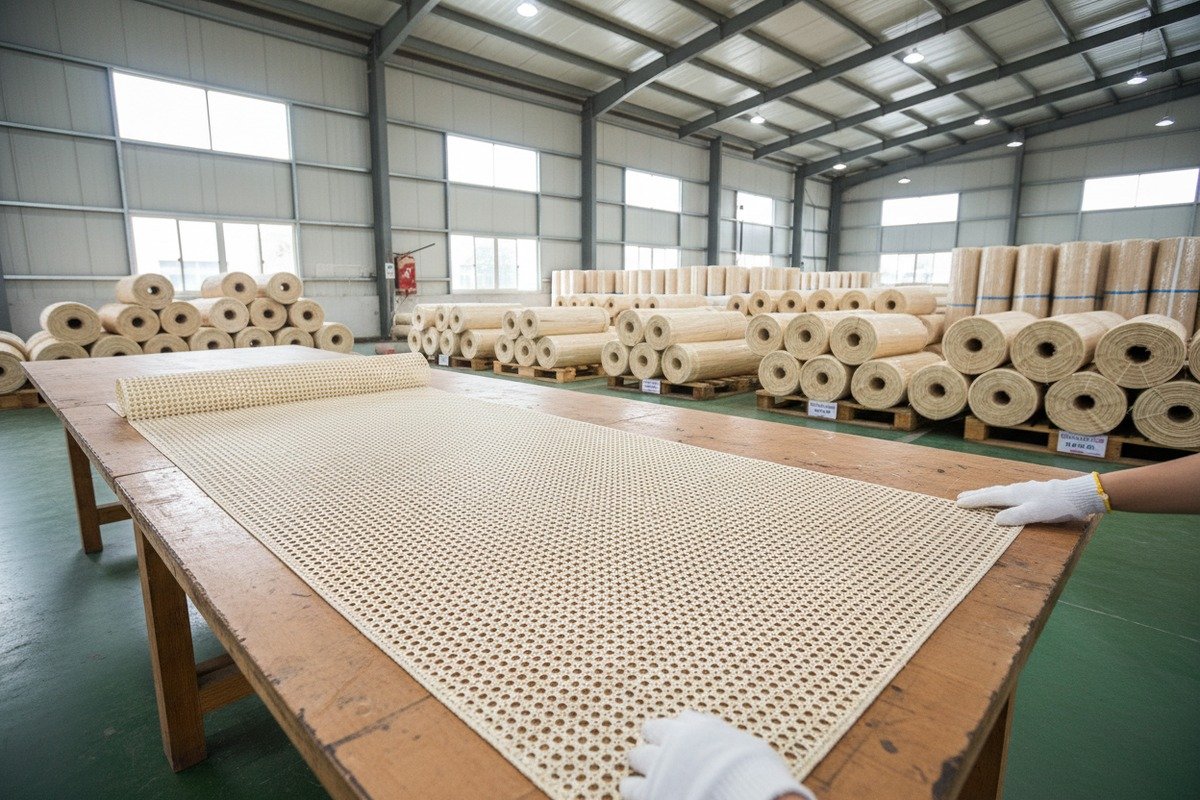
The safest approach is to source from a supplier who controls the full supply chain 9—from raw rattan harvesting and peeling in Indonesia, through processing and weaving, to final quality inspection and export packaging. We built our operation this way specifically because our furniture factory clients demanded it.
What to Look for in a Bulk Supplier
Not all rattan wholesalers are equal. Here is a checklist we recommend to every new buyer:
- Own processing facility. This means the supplier controls quality at the source.
- Grading system. Ask for their grading criteria. Grade A should have documented standards for strand thickness, color, moisture, and weave tension.
- Sample availability. Any serious supplier will send samples before you commit to a container order.
- Multiple weave options. Lighting designers need variety—hexagonal, square, diamond, basketweave, radio weave, and bleached options.
- Export experience. Ask which countries they ship to and whether they handle customs documentation.
- Packaging standards. Confirm moisture-barrier wrapping 10, reinforced cartons, and pallet options.
Comparing Sourcing Channels
Buyers typically find rattan webbing suppliers through three main channels. Each has trade-offs:
| Sourcing Channel | Pros | Cons | Best For |
|---|---|---|---|
| Direct from Wholesaler (e.g., rattanwholesaler.com) | Full quality control, custom orders, competitive bulk pricing | Requires relationship building, MOQs | Large-scale lighting manufacturers |
| Alibaba / Online Marketplaces | Wide selection, easy comparison | Inconsistent quality, middlemen markups | Small orders, initial sampling |
| Trade Shows (Canton Fair, IFFS) | Face-to-face inspection, network building | Travel costs, limited frequency | Annual procurement planning |
How We Support Lighting Manufacturers
At our Foshan headquarters, we stock over 20 standard weave patterns in natural, bleached, and synthetic rattan options. We can cut rolls to custom widths. We provide free samples to qualified buyers. And we assign a dedicated account manager to every bulk client so that communication stays clear from first sample to final shipment.
Our clients in the Netherlands, Spain, and Australia rely on us for recurring monthly orders. Many of them started with a single sample request and scaled up once they confirmed the quality. That is exactly how we prefer to work—earn trust through the product, not just promises.
For purchasing managers like Ranoo in Thailand or procurement teams in the US, we communicate primarily via WhatsApp and email for fast response times. Our goal is to make the sourcing process as painless as the material itself is beautiful.
Natural vs. Synthetic for Lighting Applications
One final consideration when buying in bulk: should you choose natural or synthetic rattan webbing for your lighting products?
Natural rattan gives an authentic, organic look and feel. It has subtle color variations and a warm, matte texture that photographs beautifully. However, it is moisture-sensitive and best suited for indoor fixtures.
Synthetic rattan (made from PVC or PE) is more durable and resistant to humidity. It works well for outdoor-adjacent lighting or commercial spaces with high foot traffic. But it lacks the organic irregularity that makes natural rattan so appealing in high-end designs.
For premium, boutique, and designer lighting lines, natural rattan is the clear winner. For commercial or hospitality projects where durability is the priority, synthetic is a practical choice. We supply both, so we help clients choose based on their end market rather than pushing one over the other.
Conclusion
Natural rattan cane webbing offers lighting designers endless creative possibilities—from shadow-casting pendants to sculptural orb lamps—when paired with quality material, proper technique, and a reliable supply chain.
Footnotes
1. Defines fabric density as a measure of thread packing in woven materials. ↩︎
2. Describes Edison-style bulbs, their appearance, and historical inspiration. ↩︎
3. Explains what LED strips are and their basic composition. ↩︎
4. Provides a botanical description and origin of rattan palms. ↩︎
5. Explains the measurement and importance of moisture content in textile materials. ↩︎
6. Explains what silica gel desiccants are and their primary function in moisture control. ↩︎
7. Defines rattan cane webbing and its origin from the rattan palm. ↩︎
8. Provides information on jute, the material from which jute cord is made. ↩︎
9. Defines supply chain management as the coordination of production flow from raw materials to delivery. ↩︎
10. Describes moisture barrier packaging and its importance for product protection. ↩︎

 English
  Español de México
  العربية
  Deutsch
  Français
  Русский