
Every week, our sales team in Foshan fields calls from furniture factories struggling with the same headaches: rising material costs, inconsistent webbing quality, and suppliers who vanish after the first order.
Wholesaling rattan cane webbing from China delivers significant cost savings through factory-direct pricing, access to Grade A Indonesian rattan processed at scale, extensive customization in patterns and dimensions, and streamlined export logistics backed by decades of experience serving over 10,000 global clients.
Below, we break down the four biggest advantages and show you exactly how to capture each one Fumigation certificates 1. Whether you run a furniture factory in Thailand or wholesale building materials in Europe, this guide is for you.
How can I lower my sourcing costs by wholesaling rattan cane webbing directly from China?
Pricing is the number one concern we hear from new buyers reaching out through our website. Many purchasing managers pay retail or near-retail rates without realizing the margin they leave on the table.
You can lower sourcing costs by 30–50% when you buy rattan cane webbing directly from Chinese wholesalers who maintain their own factories in both China and Indonesia, eliminating middlemen and offering tiered bulk discounts on orders as low as one roll.

Why Factory-Direct Pricing Changes Everything
When you source through a trading company or a local distributor, you pay a markup at every step. The raw rattan peel gets harvested in Kalimantan, Indonesia 2. It moves to a processing factory. Then it goes to a weaving facility. Then it reaches a Chinese export warehouse. Finally, it lands in a trader's catalog with a 20–40% margin added.
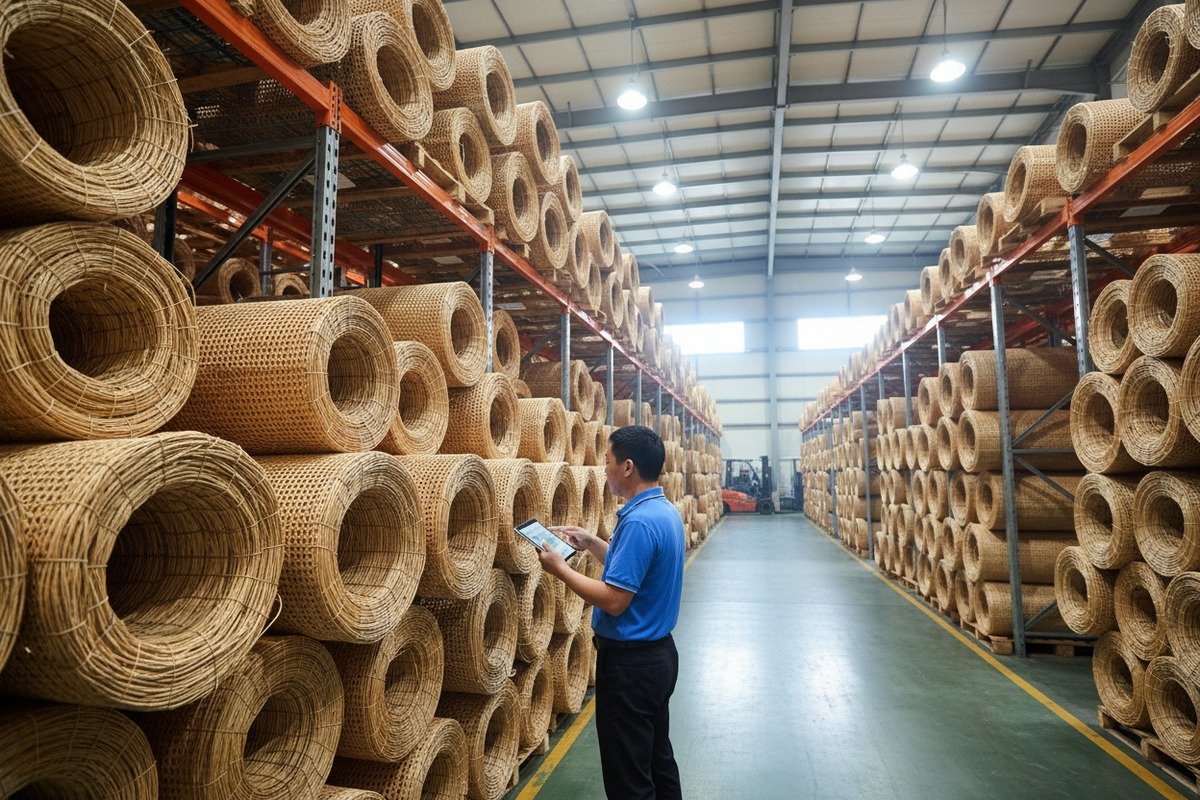
Our operation cuts most of those steps. We invested in our own 10,000+ sqm rattan raw material facility in Indonesia and a 3,000+ sqm webbing factory there as well. The finished rolls ship to our 10,000+ sqm stock warehouse in Nanhai, Foshan. By controlling the chain from harvest to export, we pass the savings to you.
Understanding Bulk Discount Tiers
Most Chinese rattan wholesalers use tiered pricing. Here is a simplified example of how pricing shifts with volume:
| Order Size | Approximate Price per Roll (60 cm × 15 m) | Discount vs. Single-Roll Price |
|---|---|---|
| 1–10 rolls | US $180–250 | Baseline |
| 11–50 rolls | US $140–200 | ~15–20% off |
| 51–200 rolls | US $110–170 | ~25–35% off |
| 200+ rolls | US $99–150 | ~35–45% off |
These numbers vary by pattern complexity and rattan grade. But the trend is clear. Volume unlocks real savings.
Hidden Costs to Watch
Low unit price means nothing if hidden fees eat your margin. Watch for these common traps:
- Fumigation certificates. Required for natural rattan entering most countries. Reputable suppliers include this at no extra charge.
- Packing quality. Cheap plastic wrap leads to crushed rolls. We use reinforced carton packaging with inner moisture barriers because a damaged shipment costs far more than good packing.
- MOQ flexibility. Some factories demand 500-roll minimums. Our MOQ starts at just 1 roll for standard items. This lets you test before committing big.
The bottom line is simple. Buying direct from a China-based wholesaler with Indonesian production assets is the single fastest way to improve your landed cost.
How do I ensure my Chinese supplier provides the consistent Grade A quality my factory needs?
Quality inconsistency is the silent killer of furniture production lines. We have seen buyers lose entire batches because their supplier mixed Grade B rattan peel into a Grade A order to save a few dollars.
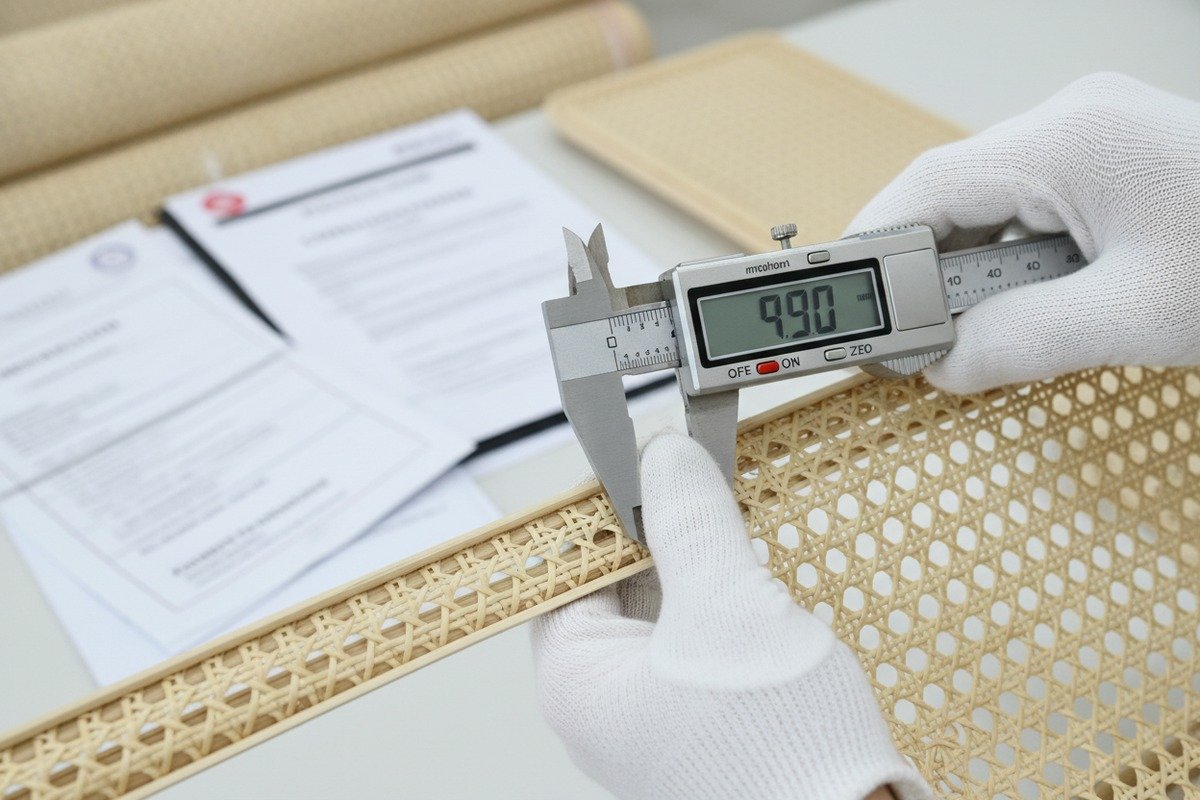
You ensure consistent Grade A quality by choosing a Chinese supplier that owns or directly controls its rattan processing facility in Indonesia, implements multi-stage inspection from raw peel sorting to final roll packaging, and provides traceable material certificates with every shipment.
What Makes Rattan "Grade A"?
Not all rattan is equal. Indonesian rattan peel—specifically from Calamus species 3—is prized for its high tenacity, uniform thickness, and natural flexibility. Grade A means:
- Consistent color (light beige to straw yellow, no dark spots).
- Uniform strand width (less than 0.5 mm variance).
- High tensile strength (no snapping during weaving).
- Smooth surface (minimal knots or rough patches).
We sort raw peel at our Indonesian factory before it even reaches the loom. Strips that fail any of the four criteria above get downgraded immediately.
The Inspection Process That Matters
A reliable supplier inspects at multiple stages, not just at the end. Here is our internal quality flow:
| Inspection Stage | What Gets Checked | Rejection Threshold |
|---|---|---|
| Raw Peel Intake | Color, moisture content, diameter uniformity | >5% defective strips → reject batch |
| Pre-Weaving Prep | Strip flexibility, surface smoothness | Any brittle or cracked strips removed |
| Mid-Production Audit | Pattern accuracy, weave tension consistency | >2% pattern deviation → halt and adjust |
| Post-Weaving Final QC | Roll dimensions, visual defects, weight per meter | >1% visible defects → downgrade to Grade B |
| Pre-Shipment Inspection | Packaging integrity, fumigation cert, labeling | Any damaged packaging → repack |
Natural vs. Synthetic: A Quality Comparison
Some buyers consider switching to synthetic (plastic) rattan webbing 4 for easier quality control. Here is an honest comparison:
| Feature | Natural Rattan Cane Webbing | Synthetic / Plastic Rattan Webbing |
|---|---|---|
| Aesthetic appeal | Warm, organic, artisanal texture | Uniform but lacks natural character |
| Tenacity & flexibility | Excellent (especially Indonesian Grade A) | Good, but can become brittle in extreme cold |
| Weather resistance | Low — best for indoor use | High — designed for outdoor exposure |
| Color variation | Natural variation (part of the charm) | Perfectly consistent (factory-dyed) |
| Sustainability | Renewable, biodegradable, no chemical pollution | Petroleum-based, not biodegradable |
| Price range (per roll) | US $99–250 | US $50–120 |
| Best application | Indoor furniture, cabinet doors, wall panels | Outdoor furniture, commercial patio seating |
Neither is "better" in every scenario. But for indoor furniture production and premium decor, natural Grade A webbing 5 from Indonesia remains the gold standard.
How to Verify Before You Buy
Ask your supplier for:
- A video tour of the weaving factory.
- Sample rolls before placing a bulk order.
- Material origin certificates showing Indonesian rattan sourcing.
- Fumigation documentation for customs clearance.
We provide all four as standard practice. If a supplier hesitates on any of these, consider that a red flag.
Can I find a one-stop shop in China for all my different rattan material and weaving requirements?
When our team first started cooperating with furniture factories across 30+ countries, we noticed a pattern. Buyers were sourcing cane webbing from one supplier, rattan poles from another, and woven panels from a third. Three invoices, three shipping schedules, three quality standards.
Yes, established Chinese rattan wholesalers like those based in Foshan offer true one-stop solutions, supplying natural cane webbing, synthetic wicker matting, bleached rattan rolls, rattan poles, and custom-woven panels—all from a single point of contact with unified quality control and consolidated shipping.
What "One-Stop" Actually Means in Practice
A genuine one-stop rattan supplier covers the full product spectrum. Here is what our catalog includes and how it maps to typical buyer needs:
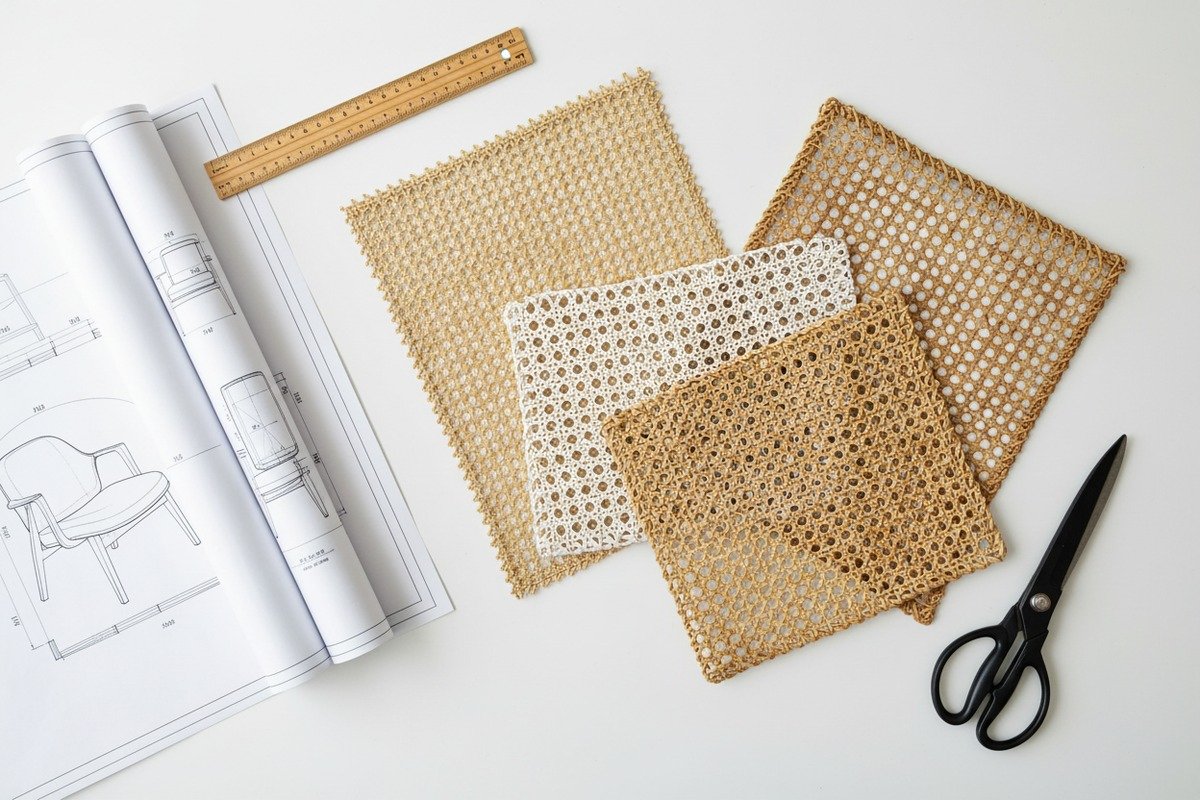
- Natural rattan cane webbing — Classic hexagonal open-mesh (radio weave), dense square basketweave, diamond motif, and more. Available in rolls 40–90 cm wide and 15 m long. Perfect for cabinet doors, headboards, and chair backs.
- Synthetic rattan matting — Chevron wave designs, tight-weave patterns in beige, tan, and light brown. Durable plastic that mimics natural wood fiber aesthetics. Built for outdoor furniture, restaurant seating, and commercial applications.
- Bleached rattan cane webbing — Natural webbing treated to achieve a lighter, whitewashed look. Popular in Scandinavian and coastal-style furniture lines.
- Rattan poles and core — Raw rattan poles in various diameters for frame construction. We keep 10,000+ sqm of rattan pole stock in our Foshan warehouse.
- Custom woven panels — Specific dimensions, patterns, and material blends produced to your specs. We cooperate with 30+ core production factories in the Foshan area for specialized orders.
Why Consolidation Saves More Than Just Money
Consolidating your rattan supply chain 6 with one partner delivers benefits beyond price:
- Fewer shipping containers. Combine webbing, poles, and panels in one container instead of three partial loads. This dramatically cuts freight cost per unit.
- Unified quality standard. One supplier means one QC protocol. The rattan pole matches the webbing color because both came from the same Indonesian raw material batch.
- Single communication channel. One WeChat or WhatsApp contact. One invoice. One tracking number. Your purchasing manager saves hours every week.
- Faster problem resolution. If a roll arrives damaged, you deal with one company, not three finger-pointing suppliers.
Customization Capabilities
Many buyers need non-standard specifications. Our production network handles:
- Custom widths from 40 cm to 90 cm.
- Custom patterns including client-provided designs.
- Color treatments: natural, bleached, stained, or carbonized.
- Material blends: natural rattan with seagrass or paper cord accents.
Lead times for custom orders typically run 10–15 business days for production plus 8–20 days for international shipping 7, depending on destination. Standard items ship from stock within 3–5 days.
Since 2016, we have also expanded into weather-resistant plastic wicker webbing with full color options available by 2025. This hybrid approach—natural for indoors, synthetic for outdoors—lets us serve every segment of a buyer's product line from one source.
How will sourcing from China help me maintain a more competitive price point in my local market?
In conversations with our long-term clients—from Dutch furniture brands to Thai material distributors—the same question comes up every year: "How do I keep my prices sharp when my competitors are undercutting me?"
Sourcing rattan cane webbing from China helps you maintain competitive local pricing by leveraging factory-direct wholesale rates, flexible MOQs that reduce dead stock, efficient export logistics with fumigation-ready shipments, and the ability to offer both premium natural and budget-friendly synthetic options to capture every market segment.
The Margin Math That Matters
Let us walk through a real scenario. Say you are a furniture material wholesaler in Bangkok. Your local competitor buys natural rattan webbing from a Vietnamese middleman at US $200 per roll. You source the same Grade A quality direct from our Foshan warehouse at US $130 per roll for a 100-roll order. Your per-roll margin advantage is US $70 before you even set your resale price.
If you sell at US $190 per roll—undercutting the competitor by 5%—you still pocket US $60 per roll. On 100 rolls, that is US $6,000 in additional gross profit per order. Over a year with monthly reorders, the number adds up fast.
Speed to Market as a Competitive Edge
Price is only part of the equation. Speed matters too. Here is how our export infrastructure supports fast turnarounds:
- Stock items ship in 3–5 business days from our Foshan warehouse.
- Custom orders take 10–15 business days for production.
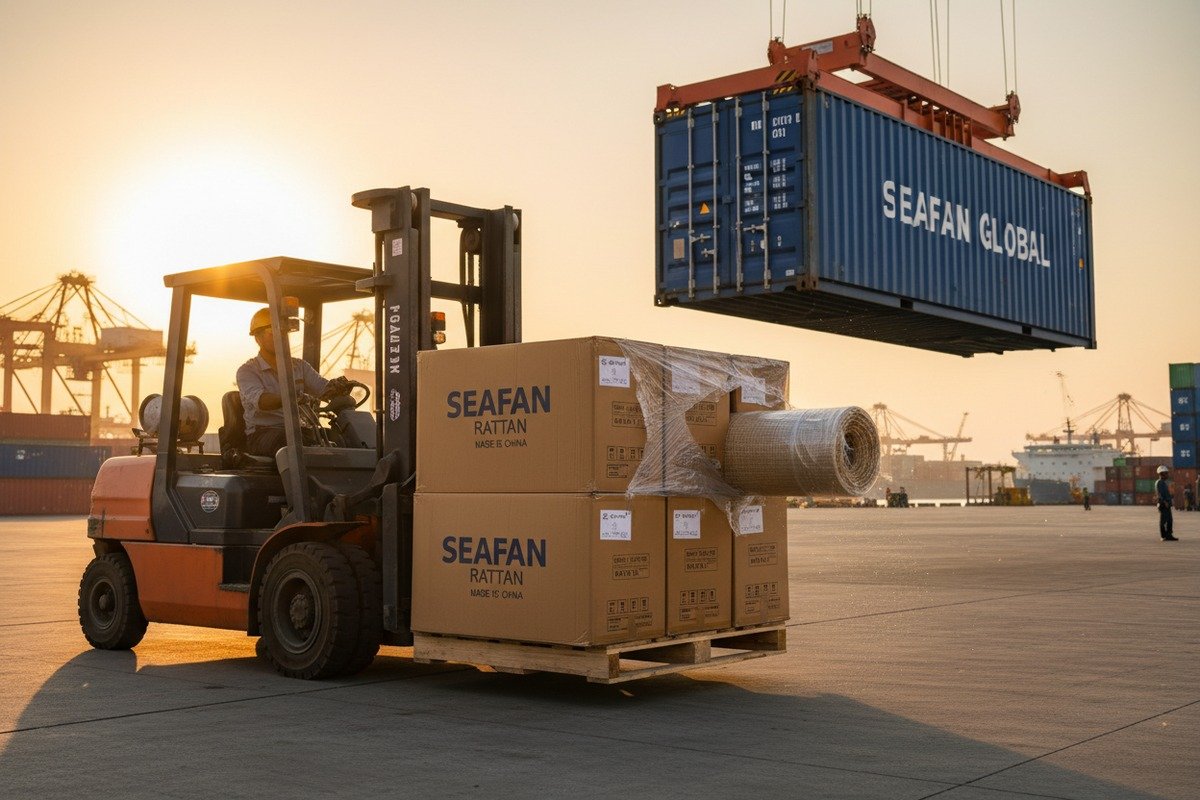
- Sea freight to Southeast Asia averages 8–12 days. To Europe, 20–25 days. To the US West Coast, 15–20 days.
- Fumigation certificates are prepared in advance for all natural rattan shipments, so your goods clear customs without delays.
We have been exporting since 1995. Over those 30 years, we have built relationships with freight forwarders 8 and customs brokers in every major port. That experience translates into fewer delays and lower logistics costs for you.
Dual Product Strategy: Natural + Synthetic
One of the smartest moves we see from successful wholesalers is offering both natural and synthetic rattan webbing. Natural cane commands premium prices for indoor furniture and boutique decor. Synthetic plastic webbing captures the budget-conscious and outdoor furniture segments.
By sourcing both from one Chinese supplier, you:
- Cover the full price spectrum in your market.
- Reduce the risk of losing customers to competitors who offer what you do not.
- Negotiate better overall pricing because your total order volume is higher.
Protecting Your Margins Against Rising Costs
Indonesia's 2011 ban 9 on raw rattan exports pushed processing costs higher over the past decade. Premium Indonesian rattan now costs more than alternatives from Vietnam or mainland China. But the quality difference justifies the premium—especially for Grade A applications.
To protect your margins:
- Lock in pricing with annual supply agreements.
- Order in bulk during off-peak seasons (typically Q1 and Q3) when factory capacity is more available.
- Mix your product line with some synthetic items to balance your average cost of goods sold.
- Build safety stock of your top-selling patterns so you never pay rush-order premiums.
Our team works with each client to build a sourcing calendar that keeps costs predictable. That kind of planning is what separates a thriving wholesaler from one constantly chasing quotes.
Conclusion
Wholesaling rattan cane webbing from China gives you lower costs, reliable Grade A quality, one-stop convenience, and the pricing power to win in your local market. The advantages are real and measurable.
Footnotes
1. Explains fumigation certificates, their purpose, and international shipping requirements like ISPM 15. ↩︎
2. Authoritative overview of Kalimantan, Indonesia. ↩︎
3. Provides information on Calamus rotang, a key rattan species, and its characteristics. ↩︎
4. Explains synthetic poly rattan webbing, its properties, and applications in outdoor furniture. ↩︎
5. Details quality grades for natural rattan webbing, emphasizing Grade A characteristics and origin. ↩︎
6. Explores sustainable rattan supply chain practices and their benefits for local communities. ↩︎
7. Explains the international shipping process step-by-step. ↩︎
8. Explains the role and functions of freight forwarders in organizing international goods transportation. ↩︎
9. News article detailing Indonesia’s 2011 raw rattan export ban. ↩︎


 English
  Español de México
  العربية
  Deutsch
  Français
  Русский