
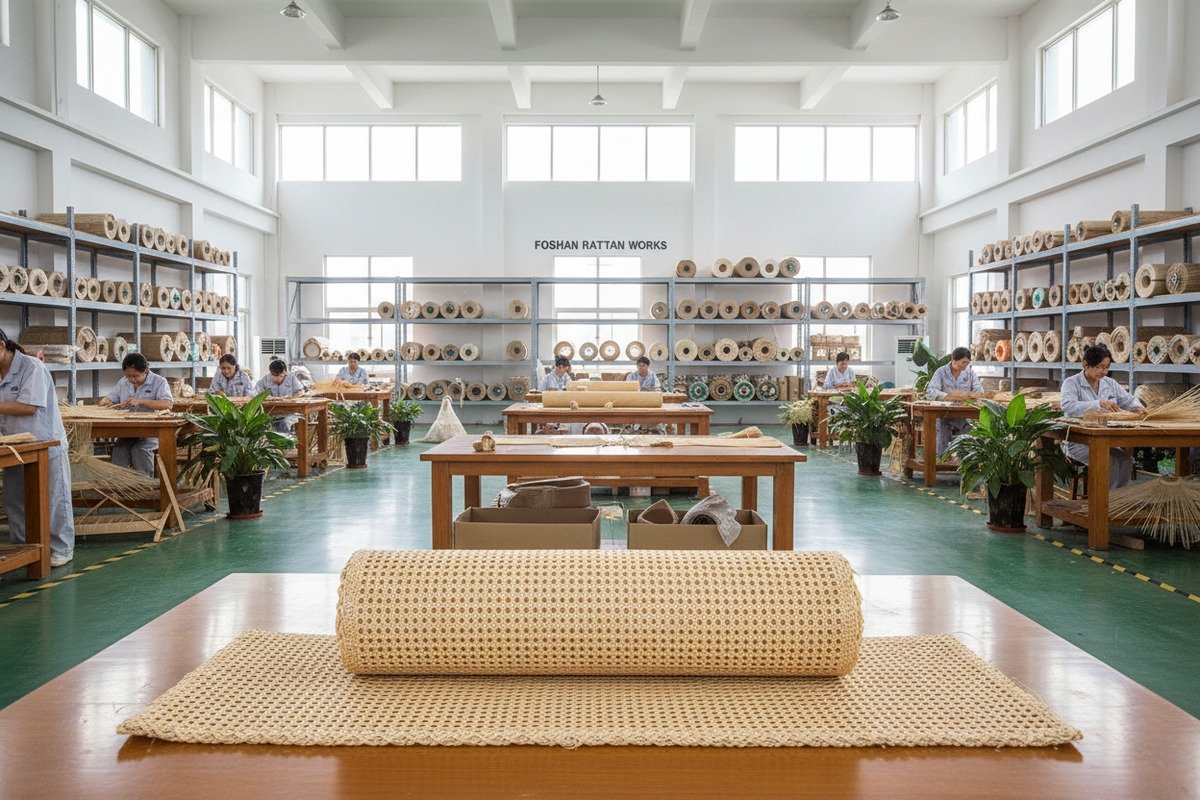
Every week, our production team in Foshan receives calls from furniture factories asking the same question — why does some rattan cane webbing 1 crack, warp, or fall apart after just a few months? The answer almost always traces back to the weaving process hexagonal, square, or diamond designs 2. A poor weave means a poor product. And when you are buying in bulk for commercial furniture lines, a defective batch can cost you thousands in returns and lost trust with your own customers.
Rattan cane webbing is produced through a structured process that includes harvesting raw rattan, stripping it into uniform strands, treating it with soaking and anti-mildew solutions for pliability, and then weaving the strands into patterns like hexagonal, square, or diamond designs using hand or semi-automated techniques.
Understanding each step of this process helps you make better purchasing decisions. Below, we break down every stage — from raw material checks to custom pattern requests — so you know exactly what to look for and what to ask your supplier.
How do I know if the raw rattan is processed correctly before the weaving begins?
Our factory in Indonesia processes raw rattan poles 3 daily, and we have learned that even a small shortcut during preparation leads to big problems during weaving. If the strands are too dry, they snap. If they are over-soaked, they lose structural strength. Buyers rarely see this stage, but it determines everything.
Correctly processed raw rattan should be uniformly stripped to consistent widths (typically 4–6 mm), soaked or boiled for 20–30 minutes until pliable, treated with anti-mildew and bleaching agents if needed, and dried to a stable moisture content before weaving begins.
Harvesting and Stripping
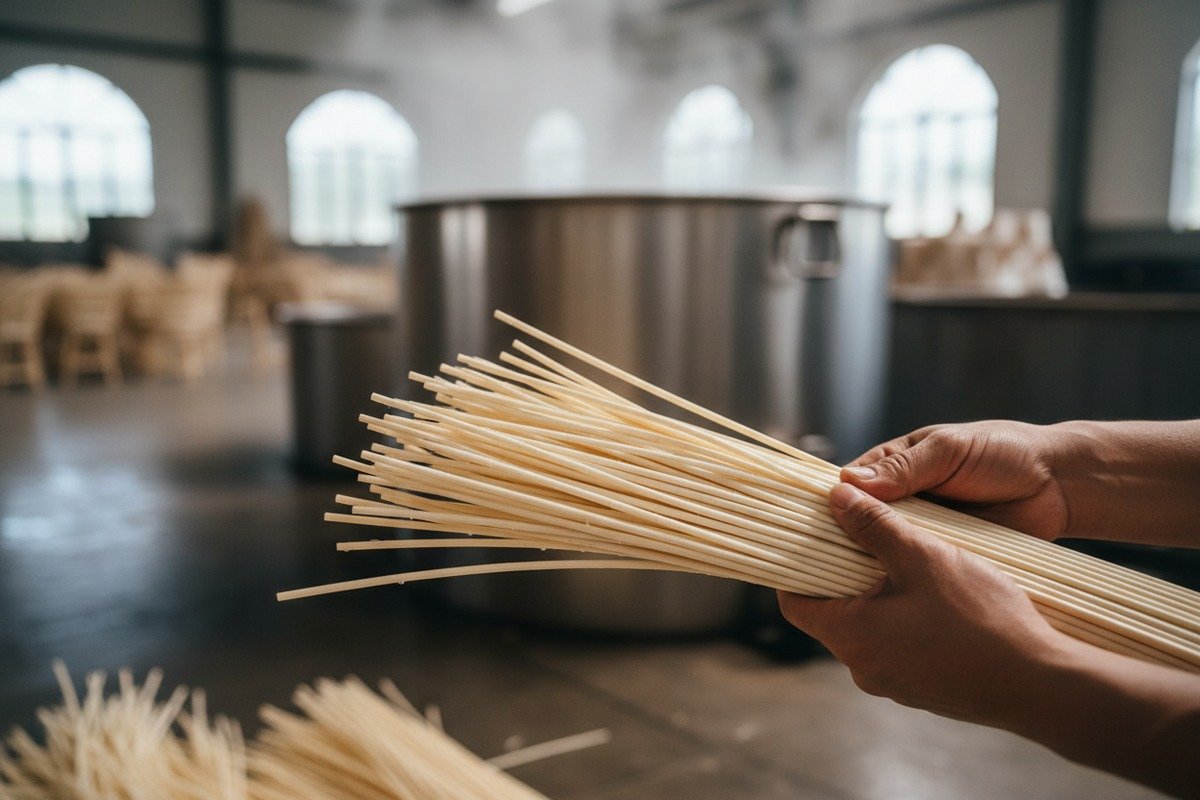
Raw rattan comes from palm plants grown primarily in Indonesia, the Philippines, and other Southeast Asian countries. The poles are harvested, then the outer skin (peel) is separated from the inner core. This peel is what becomes cane webbing. The core is used for other products like rattan sticks or furniture frames.
Stripping is done with sharp knives or mechanical splitters. The goal is to get strands of uniform width and thickness. If the strands vary too much in size, the woven sheet will have gaps or uneven tension. In our processing facility, we sort strands by diameter and grade before they move to the next stage.
Soaking, Boiling, and Treatment
Before any weaving can happen, the stripped strands must be softened. This is done by soaking in warm water or boiling for 20 to 30 minutes. The heat and moisture relax the natural fibers, making them flexible enough to bend without cracking. During a long weaving session, strands may need to be re-soaked multiple times.
Additional treatments are applied depending on the product grade:
| Treatment Step | Purpose | Duration |
|---|---|---|
| Warm water soaking | Soften fibers for pliability | 20–30 minutes |
| Boiling | Deep softening for tight weaves | 15–20 minutes |
| Bleaching | Achieve uniform light color | Varies by grade |
| Anti-mildew coating 4 | Prevent mold during storage and shipping | Applied post-drying |
| UV-resistant sealant | Improve durability for indoor/outdoor use | Applied as finishing coat |
What to Check as a Buyer
Ask your supplier for the strand diameter range they use. High-quality webbing typically uses 4–6 mm strands. Ask about their treatment process — do they apply anti-mildew agents? How do they control moisture content 5 before weaving? A reliable supplier should be able to answer these questions clearly. When we ship samples to clients in the Netherlands or Australia, we include a processing spec sheet so buyers know exactly what they are getting.
Over-treatment is also a risk. Some factories boil strands too long, which weakens the fibers. The rattan looks fine but loses tensile strength 6. Minimal, controlled processing preserves the natural durability of the material while ensuring it is flexible enough for tight, clean weaves.
What are the key stages in the industrial weaving process for my cane webbing orders?
When we run a production batch at our Foshan partner factories, the entire weaving process follows a strict sequence. industrial weaving process 7 Skipping or rushing any stage shows up in the final product — loose weaves, misaligned patterns, or webbing that does not lay flat on furniture frames.
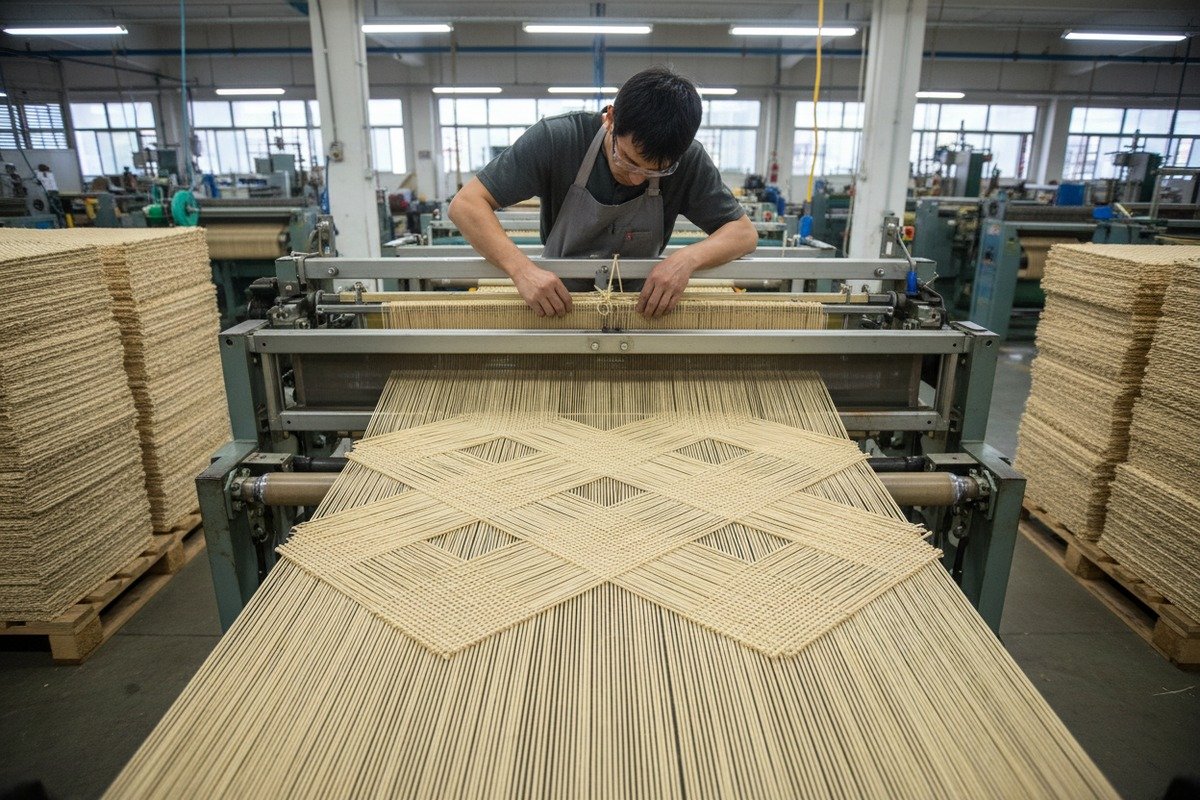
The industrial weaving process for rattan cane webbing follows five key stages: strand preparation and grading, frame setup and vertical strand laying, horizontal interlacing to form the pattern, edge finishing and trimming, and post-weave quality inspection before rolling and packaging.
Stage 1: Strand Preparation and Grading
Before weaving starts, strands are sorted by width, color, and flexibility. Grade A strands are reserved for premium orders. Strands with visible knots, discoloration, or uneven thickness are set aside for lower-grade products or rejected entirely. This grading step directly impacts the final appearance and strength of the webbing.
Stage 2: Setting Up the Weaving Frame
For machine-assisted weaving, strands are loaded onto a loom-like frame. For hand-weaving, artisans pin vertical strands (the warp) onto a flat board or frame at consistent intervals — typically following a 1-inch or half-inch grid depending on the pattern density. warp and weft 8 The warp strands must be taut and evenly spaced. Any slack here means the finished sheet will have inconsistencies.
Stage 3: Interlacing the Pattern
This is where the pattern takes shape. Horizontal strands (the weft) are woven through the vertical strands using an over-under technique. The specific pattern determines the method:
| Weaving Pattern | Technique | Common Use |
|---|---|---|
| Square (Radio Cane) | Simple over-1, under-1 grid | Chair seats, cabinet panels |
| Hexagonal (Open Weave) | Square base with diagonal edge strips forming honeycomb | Decorative screens, doors |
| Herringbone | Angled over-under creating V-shapes | Premium furniture accents |
| French Weave | Octagonal open pattern with fine strands | High-end European-style chairs |
| Diamond Motif | Complex geometric interlacing | Bespoke interior panels |
For hexagonal weaving, the process starts with a square grid base. Then additional strands are woven diagonally across the intersections to create the honeycomb effect. This requires more skill and time than a simple square weave. The traditional 7-step cane seat method involves phased over-under patterns — for example, over 1 then under 1 in the first pass, then over 2 and under 2 in subsequent passes, working just 1 to 3 strands at a time to avoid twisting.
Stage 4: Edge Finishing and Trimming
Once the sheet is fully woven, edges are trimmed with sharp knives or scissors. Loose ends are tucked or glued. For webbing sold in rolls, the edges are finished to prevent fraying during transport. Some orders require binding strips along the edges for extra durability, especially if the webbing will be inserted into grooves with splines.
Stage 5: Post-Weave Inspection
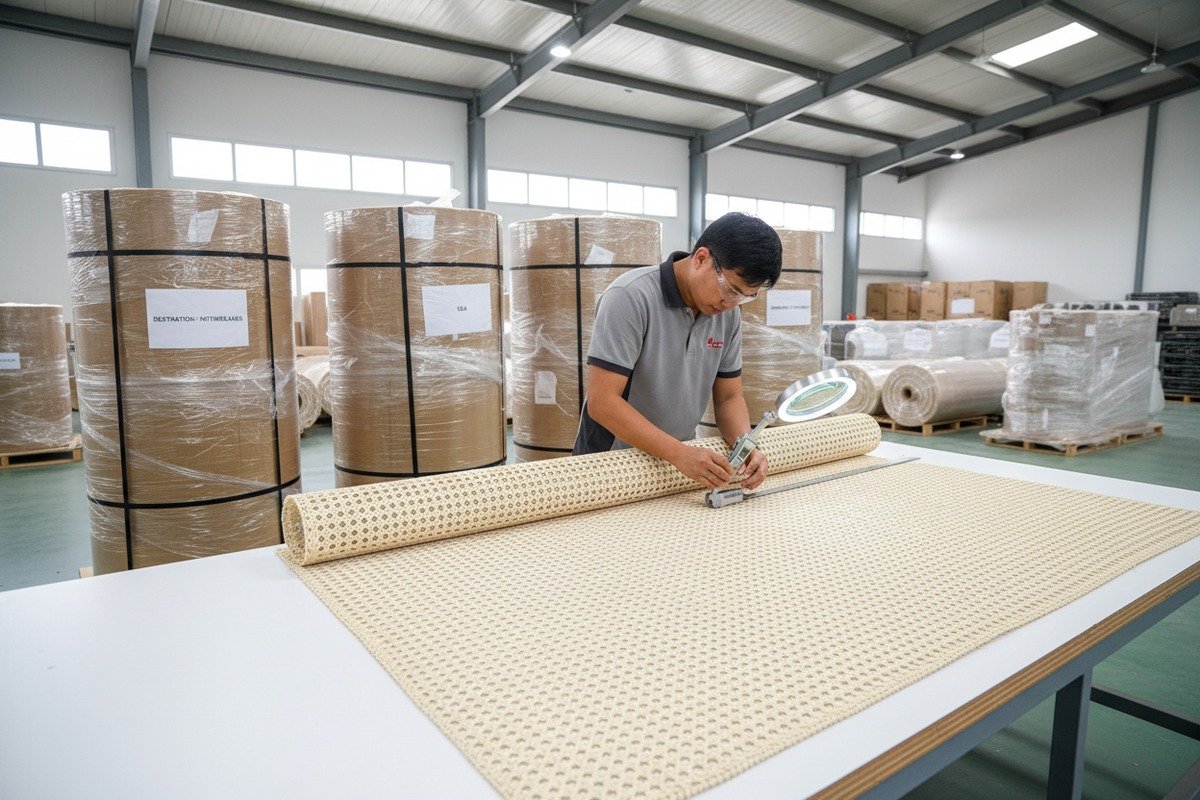
Every batch goes through visual and tactile inspection. Workers check for weave uniformity, strand breakage, pattern alignment, and overall flatness. Sheets that do not meet grade standards are rejected or downgraded. In our production line, we use a two-person inspection system — one checks the front surface, the other checks the back — to catch defects that a single inspector might miss.
Hand Weaving vs. Machine Weaving
Traditional hand-weaving preserves artisanal character. Each sheet has subtle, organic variations that many designers value. But hand-weaving is slower and more expensive. Machine-assisted weaving (semi-automated looms) can increase efficiency by 20 to 30 percent while maintaining pattern consistency. For large wholesale orders, we often recommend semi-automated production to balance quality with delivery speed.
How can I identify high-quality weaving standards to avoid defects in my furniture?
Over the years, we have seen buyers receive shipments that looked fine in photos but fell apart once installed on furniture frames. The difference between Grade A and a substandard product is not always visible in a single sample photo. You need to know what to look for — and what to ask before placing your order.
High-quality rattan cane webbing shows uniform strand spacing, consistent color without dark spots or mildew, tight and even interlacing with no gaps or loose strands, clean trimmed edges, and flexibility without brittleness when bent by hand.

Visual Inspection Checklist
When evaluating a webbing sample or inspecting a delivered batch, use a systematic approach. Here are the key indicators we train our quality control team to check:
Strand uniformity. All strands in the sheet should be close in width and thickness. If you see some strands noticeably thinner or thicker than others, the grading step was skipped or poorly done.
Color consistency. Natural rattan has some variation — that is normal. But large patches of dark brown, green tinting, or grey spots indicate mold, inadequate drying, or poor bleaching. Bleached webbing should have an even cream or light straw tone across the entire roll.
Weave tightness. Push gently on the surface. The weave should flex slightly but not shift. If individual strands slide or rotate under light pressure, the tension during weaving was too loose.
Edge quality. Look at the edges of the roll or sheet. Frayed, uneven, or split ends suggest poor finishing. Premium webbing has clean-cut edges, sometimes with a binding strip.
Common Defects and Their Causes
| Defect | Likely Cause | Impact on Furniture |
|---|---|---|
| Loose or shifting strands | Insufficient weaving tension | Webbing sags or deforms under load |
| Dark spots or mildew | Inadequate drying or no anti-mildew treatment | Aesthetic damage, potential health concern |
| Cracking strands | Over-dried or under-soaked material | Webbing breaks during installation or use |
| Uneven pattern spacing | Poor frame setup or unskilled weaving | Visible defect on finished furniture |
| Curling edges | Uneven moisture content across the sheet | Difficult to install flat on panels |
| Strand splitting | Low-grade rattan or over-boiling | Structural weakness, short product lifespan |
The Bend Test
One simple test we recommend to all our buyers: take a single strand from the webbing and bend it sharply between your fingers. A high-quality strand bends smoothly without cracking. It should feel supple, not stiff or brittle. If it snaps cleanly, the material was either over-dried, poorly treated, or made from low-grade rattan.
Why Packaging Matters
Even perfectly woven webbing can arrive damaged if packaging is poor. We use moisture-controlled wrapping and rigid tubes for roll shipments. Flat sheets are stacked with protective paper between layers. For exports to humid climates like Thailand or the Philippines, we add silica gel packets inside the packaging to prevent mold during transit. Ask your supplier about their packaging standards — it is just as important as the weaving itself.
Requesting Pre-Shipment Inspection
For large orders, always request a pre-shipment inspection report. This should include photos of the weave pattern, close-ups of strand quality, and a note on moisture content. At our facilities, we provide video inspections via WhatsApp for key accounts, so buyers can see the product before it ships. This small step prevents most quality disputes.
Can I request specific weaving patterns or custom sizes for my factory's unique designs?
We get custom requests every month — from furniture factories in Spain needing a specific hexagonal mesh density to Australian designers wanting oversized sheets for architectural wall panels. Customization is possible, but it comes with considerations around minimum order quantities, lead times, and cost.
Yes, most established rattan webbing suppliers can produce custom weaving patterns, strand widths, mesh densities, and sheet dimensions to match your specific furniture or interior design requirements, typically subject to minimum order quantities and extended production lead times.
What Can Be Customized?
Almost every aspect of the webbing can be adjusted. Here is what our clients most commonly request:
Pattern type. Beyond standard hexagonal and square weaves, we produce herringbone, French weave, chevron, and diamond patterns. If you have a design sketch, our production team can usually replicate it or suggest the closest feasible pattern.
Strand width and thickness. Standard strands range from 2 mm to 6 mm. Wider strands create a bolder, more rustic look. Thinner strands allow for finer, more delicate patterns. The choice affects both aesthetics and structural strength.
Mesh density. This refers to how tightly the strands are spaced. A tighter mesh gives more coverage and support — ideal for chair seats. An open mesh lets more light and air through — better for decorative screens or speaker covers in smart home applications.
Sheet size. Standard rolls come in widths of 45 cm, 60 cm, and 90 cm, with lengths of 10 to 50 meters. Custom widths up to 120 cm are possible for architectural panels, though they require wider looms and carry a price premium.
Color and finish. Natural, bleached, or stained — the choice is yours. Some clients request UV-resistant coatings for products that will be used in sunlit interiors or semi-outdoor settings.
Custom Order Considerations
| Factor | Standard Orders | Custom Orders |
|---|---|---|
| Minimum Order Quantity | 100–500 meters | 500–2,000 meters typical |
| Lead Time | 7–15 days | 20–45 days |
| Sampling | Free from stock | $50–$150 per custom sample |
| Price Premium | Base price | 10–30% above base |
| Pattern Complexity | Pre-set on looms | May require loom adjustment |
Natural vs. Synthetic for Custom Work
Some clients ask whether synthetic rattan (PE-based) is better for custom orders. Synthetic webbing offers superior weather resistance and color consistency, making it ideal for outdoor furniture or high-humidity environments. But natural rattan has an organic texture and warmth that synthetic versions cannot fully replicate. For indoor furniture targeting the bohemian, mid-century, or Scandinavian aesthetic, natural rattan remains the preferred choice.
We offer both options and can produce custom patterns in either material. For clients in the Middle East — Saudi Arabia, Dubai, Iran — where outdoor use and heat resistance matter, we often suggest synthetic cane webbing with a natural finish look. For European and Australian markets focused on eco-friendly interiors, natural rattan with FSC-certified sourcing 9 is the stronger selling point.
Digital Design and New Possibilities
Innovations in digital design tools 10 now allow us to model custom weave patterns before production begins. Clients send CAD files or reference images, and our design team creates a digital mockup showing how the pattern will look on the finished furniture. This saves time and reduces the risk of producing a pattern that does not meet expectations. Automated weaving technologies are also enabling more complex patterns that go beyond traditional geometric designs, opening new possibilities for bespoke interior and furniture projects.
Tips for Placing a Custom Order
Start with a clear specification document. Include the pattern name or reference image, desired strand width, mesh density, sheet dimensions, color or finish preference, and intended use (chair seat, cabinet door, wall panel, etc.). The more detail you provide upfront, the faster we can quote and sample. Send your specs via email or WhatsApp — our team typically responds with a feasibility assessment within 24 to 48 hours.
Conclusion
The rattan cane webbing process — from raw material preparation through weaving to final quality inspection — determines the durability, beauty, and value of your finished furniture products. Understanding these stages helps you choose the right supplier and avoid costly defects.
Footnotes
1. Provides a comprehensive overview of rattan, its uses, and processing. ↩︎
2. Introduces fundamental weaving patterns and techniques used in textiles. ↩︎
3. Explains the origin, harvesting, and initial processing of rattan plants. ↩︎
4. Describes the purpose and types of coatings used to prevent microbial growth. ↩︎
5. Explains the importance of moisture content in wood and similar hygroscopic materials. ↩︎
6. Defines tensile strength as a material’s resistance to breaking under tension. ↩︎
7. Describes the general stages and machinery involved in industrial textile weaving. ↩︎
8. Clearly defines the two fundamental components of woven fabric. ↩︎
9. Explains the Forest Stewardship Council certification for sustainable forestry. ↩︎
10. Discusses the role of digital tools in modern manufacturing processes and design flexibility. ↩︎


 English
  Español de México
  العربية
  Deutsch
  Français
  Русский